
In 2026, Artificial Intelligence (AI) will continue to shape the future by being integral to addressing the most complex challenges people face, from healthcare access to the climate change crisis. In 2025, 88% of organizations used AI in at least one business function-remarkable growth from 78% in 2024.
AI engineers have become indispensable across industries such as software engineering, manufacturing, oil and gas, renewable energy, fintech, edtech, and medical technology. Programming, cybersecurity, data science, machine learning (ML), and robotics are the most in-demand skills.
Due to the increased demand for AI knowledge across various businesses, an AI engineer salary increased significantly between 2024 and 2025. In 2025, AI specialists earned 18.7% more – up from 15.8% in 2024—showing companies are willing to pay a premium for top AI talent.
How much do AI engineers make in 2026? Qubit Labs conducted in-depth research to help you comprehensively understand the average AI engineer salary worldwide. This article will provide an overview of the salaries by location, expertise, and role.
Key Takeaways:
- Generative AI, multimodal AI, and AI in science and healthcare are the major trends driving the salary for an AI engineer.
- USA, Canada, and Australia offer the highest wages: $147,524, $129,850, and $128,400, respectively.
- In Western Europe, mid-level AI engineers earn $72,000 in the UK and $160,300 in Switzerland.
- Eastern Europe offers ~ $48,800, on average.
- The Artificial Intelligence engineer salary ranges from $17,323 to $114,852 in Asia.
- In Latin America, AI engineers receive $40,800.
- Junior Computer Vision engineers have the highest salary among all AI engineer roles – $121,515.
- Middle NLP engineers command the highest salaries in the industry: $162,000. Senior machine learning engineers earn $211,000 annually.
What Is an AI Engineer?
AI engineers use their artificial intelligence and machine learning expertise to create computer systems and applications. They contribute to developing more obscure technologies that may not be immediately apparent to a broad audience, such as developing AI assistants, AI surgical robots, and self-driving cars. The required and preferred skills of AI engineers are:
- Proficiency in machine learning and deep learning.
- Mastery of Python, Java, C++, TensorFlow, and NLP.
- Understanding of functional and object-oriented design concepts and best practices.
- Knowledge of designing and optimizing RDBMSs, NoSQL databases, and REST APIs.
- A bachelor’s or master’s degree in computer science or a similar discipline.
- Familiarity with cloud environments.
- Strong communication and time-management skills.
What Does an AI Engineer Do?
Depending on the experience level and role, an AI and ML engineer can perform various functions. Here is a brief overview of the primary responsibilities:
- Creating and implementing machine learning algorithms.
- Building the infrastructure for data transformation.
- Using machine learning to automate various processes.
- Maintaining data security and privacy.
- Creating and managing AI strategies.
- Collaborating with proficient engineers and executives to work on functional design, process design, prototyping, training, and testing of ML models.
- Leading a research team that analyzes the automation, AI market, and competitive environment.
- Ensuring alignment between project teams and stakeholders, providing input, and empowering team members to alter the performance or appearance of the final product as needed.
Different Kinds of AI Engineers
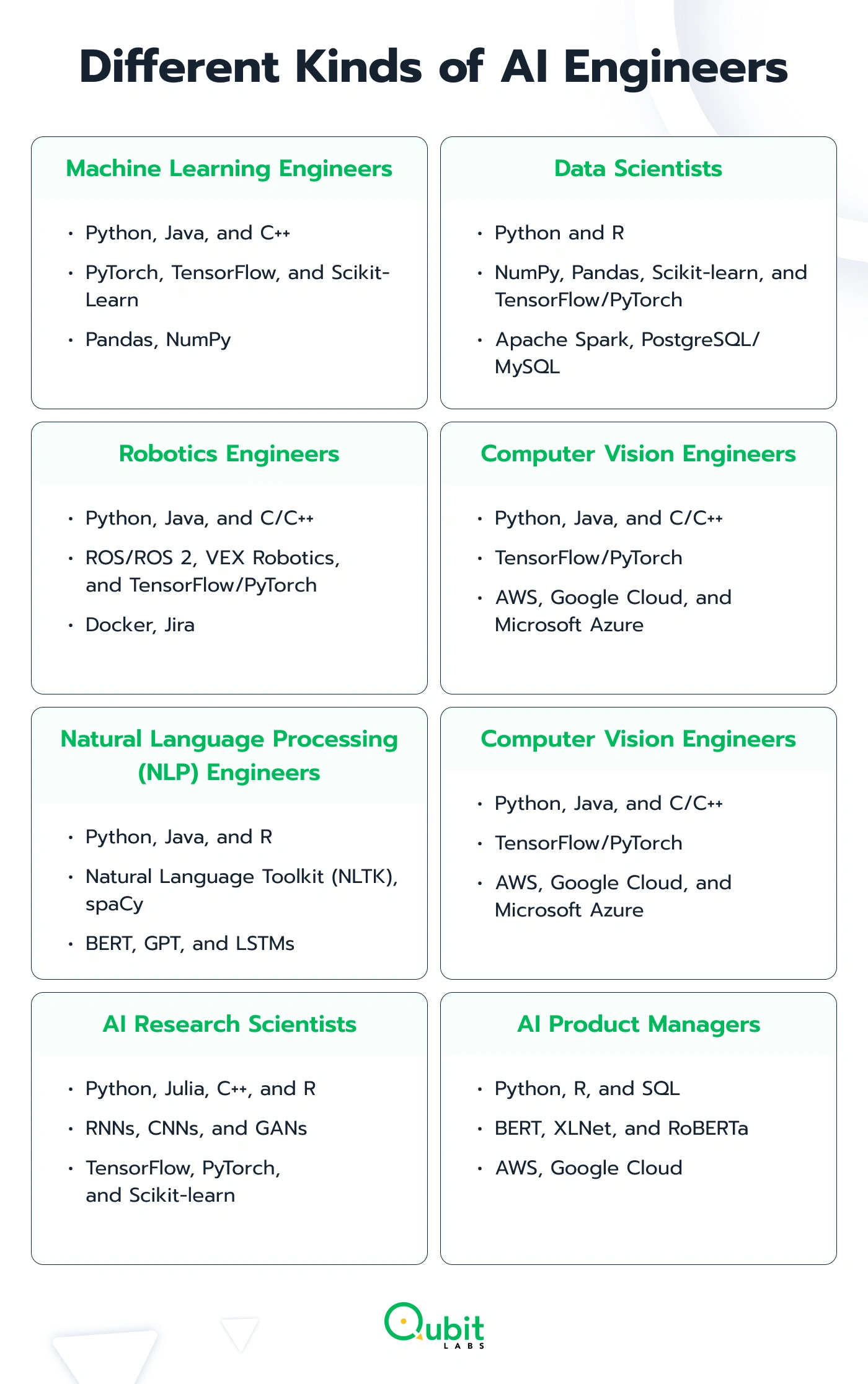
Artificial intelligence engineering is a diverse and dynamic industry with numerous specialized roles. We’ll consider the most popular ones.
Machine Learning Engineers
These developers are responsible for designing, building, and optimizing systems that enable AI and ML models to run smoothly and autonomously. They also integrate models into various apps and improve their performance for maximum efficiency. They should be proficient in PyTorch, TensorFlow, and Scikit-Learn to perform these responsibilities.
Data Scientists
Data scientists use ML algorithms, statistical techniques, and visualization tools to analyze and interpret large datasets, identify common trends, forecast outcomes, and develop actionable strategies. Their tech stacks include knowledge of Python, R, NumPy, Pandas, Scikit-learn, TensorFlow/PyTorch, Apache Spark, PostgreSQL/MySQL, MongoDB, and Git/GitHub.
Robotics Engineers
These specialists design, build, operate, test, and debug robots and robotic systems across various industries, including healthcare, automotive, manufacturing, agriculture, and aerospace. They should be proficient in Python, Java, C/C++, ROS/ROS 2, VEX Robotics, Gazebo, Webots, TensorFlow/PyTorch, Docker, and Jira.
Computer Vision Engineers
They are highly skilled specialists who develop hardware and software to process visual input and identify objects and people. They interpret large amounts of data to address real-world issues. Their tech expertise includes Python, Java, and C/C++ knowledge, proficiency in TensorFlow/PyTorch, knowledge of image processing techniques (image filtering, feature extraction, segmentation, etc.), mastery of deep learning & neural networks, and understanding of cloud platforms and deployment tools (AWS, Google Cloud, Microsoft Azure) and version control tools (Docker, Git/GitHub).
Natural Language Processing (NLP) Engineers
These engineers ensure machines can comprehend, interpret, and respond to human language meaningfully and accurately. This is essential for language translation systems, chatbots, and virtual assistants. NLP engineers should know Python, Java, and R and demonstrate a comprehensive understanding of Natural Language Toolkit (NLTK), spaCy, various machine learning and deep learning techniques, and various NLP techniques and methods (NER, tokenization, part-of-speech tagging, etc.)
AI Research Scientists
AI research scientists investigate, create, and apply advanced AI technologies. Their contributions are essential to expanding AI’s theoretical knowledge and real-world applications. Their roles often involve knowledge of programming languages (Python, Julia, C++, and R), deep learning models (RNNs, CNNs, GANs), TensorFlow, PyTorch, and Scikit-learn, as well as mastery of NLP, generative AI, and computer vision.
AI Product Managers
AI product managers supervise the development and implementation of AI solutions to ensure that AI-driven solutions meet consumer needs and corporate objectives. They usually collaborate closely with stakeholders, data scientists, and engineers to deliver top-notch product design and lifecycle management. To perform their duties efficiently, they should know how to develop AI roadmaps and prioritize features, have a comprehensive understanding of Python, R, and SQL, and be familiar with NLP models (e.g., BERT), AWS, and Google Cloud.
Factors Influencing AI Developer Salaries

As in other disciplines, the AI software engineer salary depends on various factors, including location, expertise, education, industry demand, and the type of company they work for.
Experience Level
In this case, the strategy is the same as for other specialists: skilled AI engineers with more experience typically get better salaries than those just beginning their careers. An entry-level AI developer salary in the US is $69,362 annually, whereas a senior AI developer salary in the US is $126,557.
Educational Background
Advanced degrees (Master’s and Ph.D./MD) usually lead to higher-paying opportunities. Salary.com indicates that specialists with a high school diploma or technical certificate are most likely to earn $146,716—$158,116 annually, whereas the artificial intelligence engineer salary for experts with PhD, MD, or equivalent is $155,193—$165,936 annually.
Besides, certification in AI and machine learning, generative AI for business transformation, and IBM AI Engineering Professional guarantees better career prospects.
Location and Regional Trends in Salaries
Location and regional demand influence the AI developer salary. Countries with high cost of living and well-developed tech ecosystems, like the USA, Canada, Israel, Switzerland, Germany, Australia, and Singapore, offer significantly higher wages than Eastern European and Latin American countries. Qubit Labs research shows that, on average, the artificial intelligence salary in Eastern Europe is ~70% lower than in the USA, but software development quality remains high. These factors are pivotal for businesses that consider inhouse vs outsource software development.
Company Size
Large enterprises and tech giants usually offer more competitive salaries due to the increased demand for talent and extensive financial resources. According to ZipRecruiter, the average AI engineer salary in the US is $129,348. Meta, an established player in the global tech scene, offers generative AI developers up to $173,000/year + bonus + equity + benefits.
Demand for Specialized Skills
Unicorns and mid-size companies are searching for individuals with advanced skills, which results in higher average total compensation. Typically, tech companies are searching for talent with expertise in deep learning (TensorFlow, PyTorch, and CNNs knowledge), NLP (BERT, spaCy), computer vision (OpenCV, YOLO), and big data (Apache Spark, Hadoop, SQL, and NoSQL). This tech stack significantly increases their earning potential.
AI Engineer Salaries in the United States

The average AI engineering salary in the USA is $147,524. The highest AI software engineer salary is in San Francisco ($188,385), New York ($186,295), and McLean ($164,931). Boston offers an average AI/ML engineer salary of $153,892. The base wage ranges from $136,988 to $124,594 in Charlotte and Atlanta.
How Much Does an AI Engineer Make In the United States?
The average AI salary in US ranges from $140,000 to $150,263, based on different resources.
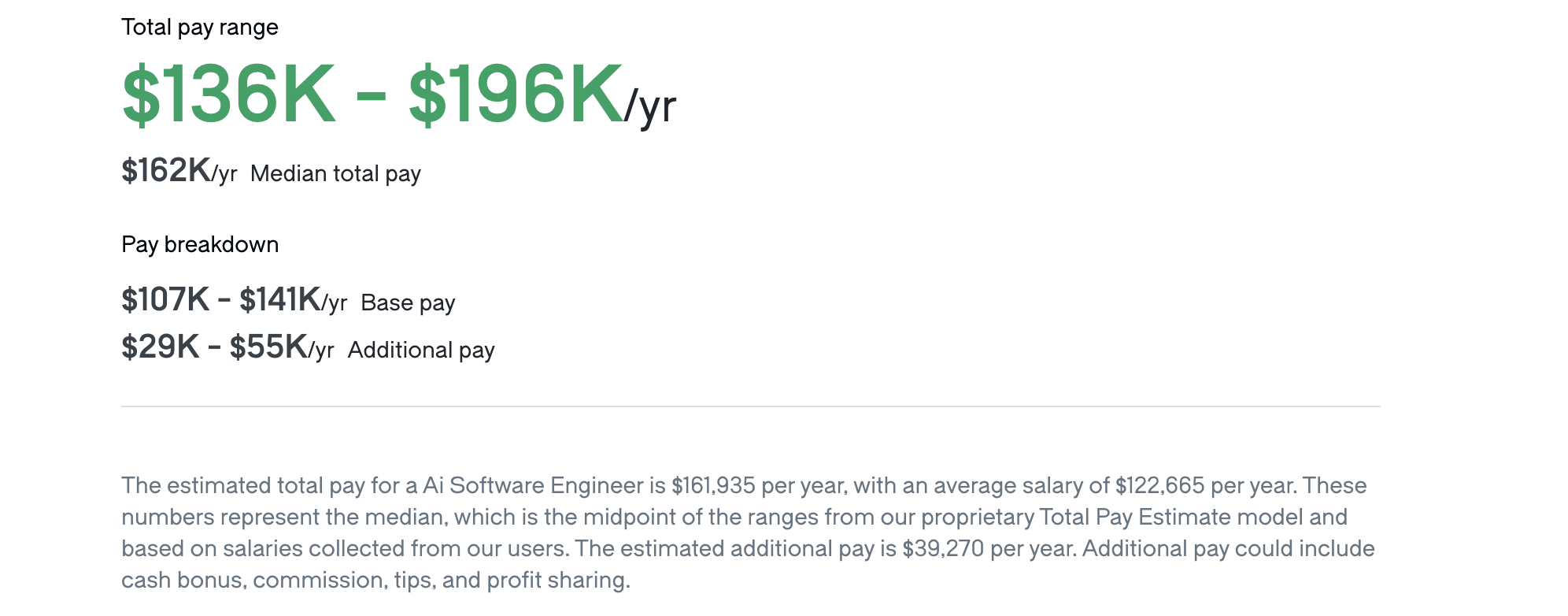
Glassdoor states that the average AI specialist salary in the USA is $140,000. The additional pay, which may include cash bonuses, tips, commissions, and profit sharing, is $39,270 annually. Therefore, the total compensation is $179,270 annually.
Source: glassdoor.com
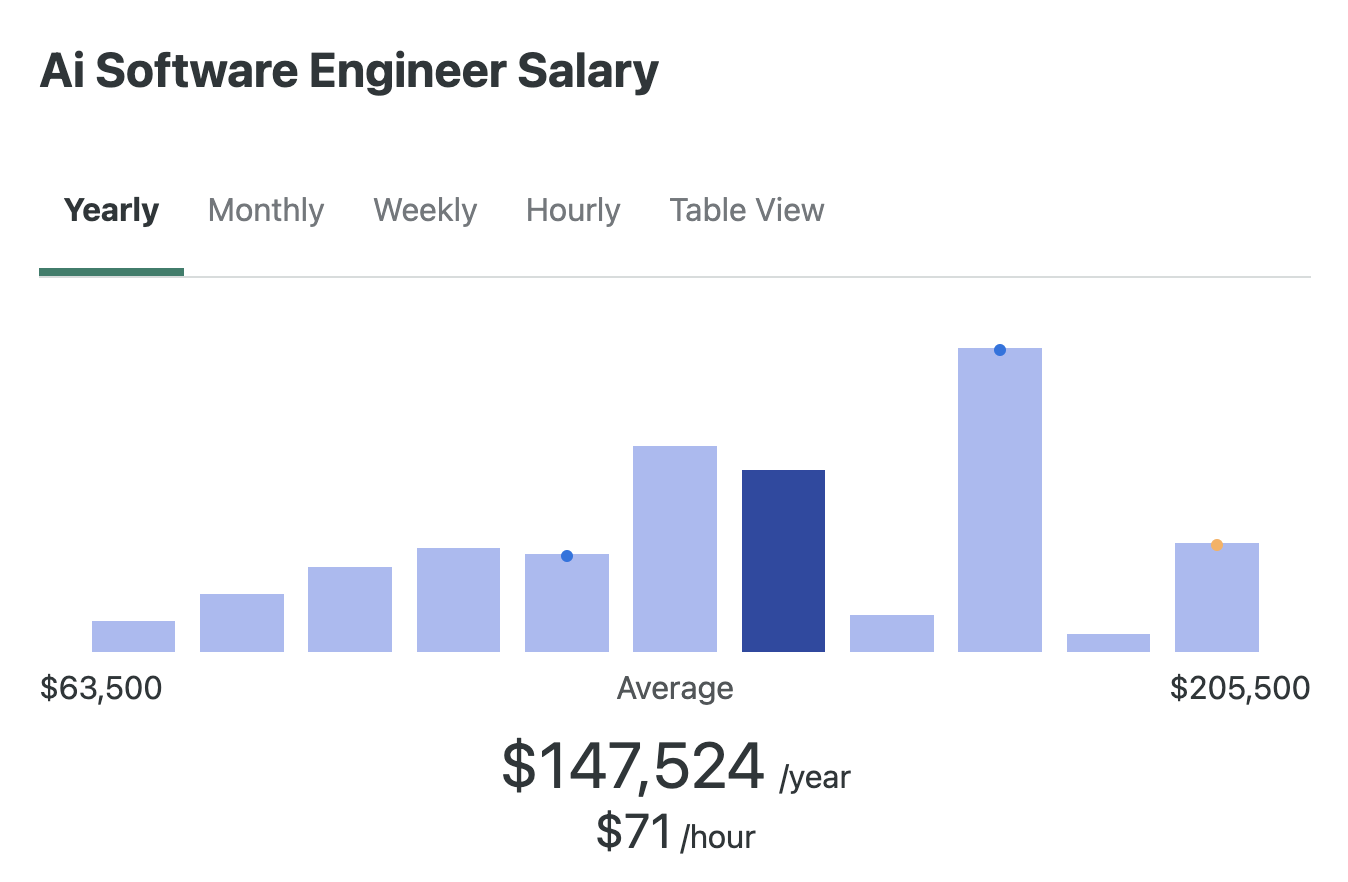
ZipRecruiter indicates that the average Artificial Intelligence salary in US is $147,524 annually, or $71 per hour.
Source: ziprecruiter.com
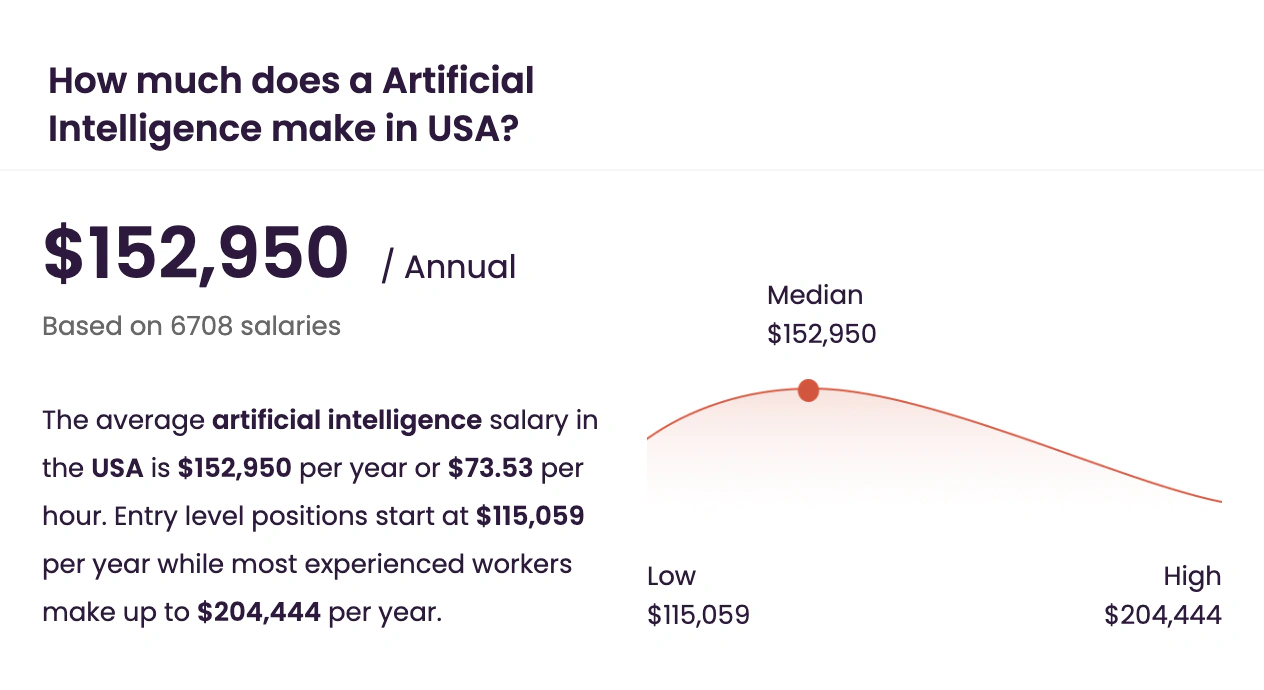
Talent.com shows that the average AI programmer salary is $152,950. The entry-level AI engineer salary in US is $115,059, and a senior AI engineer salary is $204,444 annually.
Source: talent.com
As for the AI machine learning engineer salary, Indeed states that the average yearly salary is $185,797. Mountain View ($219,544), San Francisco ($218,601 per year), and Seattle ($202,294) are the highest-paying cities.

Source: indeed.com
Here is a short overview of the average AI engineers salary.

Which US Cities Offer the Highest AI Engineer Salaries?
Kentville, NS offers the highest AI engineer average salary in the country — $180,254 per year, or an equivalent of the Artificial Intelligence salary per month of $15,021.
Here is a detailed breakdown of the highest-paying cities in the USA, according to ZipRecruiter.
| City | Annual AI Machine Learning Salary | Average Monthly Pay |
|---|---|---|
| Kentville, NS | $180,254 | $15,021 |
| Whitehorse, YT | $179,107 | $14,925 |
| Carcross, YT | $179,002 | $14,916 |
| Haines Junction, YT | $178,391 | $14,865 |
| North Cowichan, BC | $177,866 | $14,822 |
| Duncan, BC | $177,182 | $14,765 |
| Oak Bay, BC | $176,859 | $14,738 |
| Victoria, BC | $176,110 | $14,675 |
| Alberton, PE | $174,466 | $14,538 |
| Courtenay, BC | $173,997 | $14,499 |
* Salary data is sourced from ziprecruiter.com
Hourly AI Developer Rates by State
| State | Hourly Rates |
|---|---|
| California | $50 |
| New York | $56 |
| Texas | $48 |
| Wisconsin | $52 |
| North Carolina | $46 |
| South Carolina | $45 |
| Colorado | $54 |
| Minnesota | $52 |
| Georgia | $43 |
| Washington | $58 |
| New Jersey | $52 |
| Utah | $47 |
| Connecticut | $49 |
| Maine | $50 |
| Virginia | $51 |
| Massachusetts | $77 |
* Salary data is sourced from ziprecruiter.com
Massachusetts offers the highest hourly wage — $77. Washington has $58, New York — $56, and the hourly rate in Colorado — $54. California, Wisconsin, Minnesota, New Jersey, Maine, and Virginia offer almost the same hourly rate — from $50 to $52. Texas, North and South Carolina, Utah, and Connecticut offer hourly pay of $45-$49. Georgia has the lowest AI developer salary in the US — $43 per hour.
Average AI Engineer Salary in the World

How much do AI developers make? The highest-paying country in the world is the USA, with an average Artificial Intelligence specialist salary of $147,524. Other location based salaries are the following:
- Canada and Australia offer $129,850 and $128,400, respectively.
- In Western Europe, Switzerland has the highest wages — $160,300.
- As a top outsourcing destination, Eastern Europe offers competitive salaries ranging from $40,800 in Ukraine to $55,200 in Poland.
- In Asia, Singapore stands out as the country with the highest salary of AI engineer — $106,922 annually.
- In Latin America, Mexico offers the highest entry level AI engineer salary of $21,600 and the highest average salary of $40,800.
Let’s look at the AI/ML developer salary worldwide.
AI Developer Salaries in Western Europe
Western Europe boasts extensive expertise in autonomous systems and NLP. DeepMind Technologies Limited, an AI research laboratory focusing on neural networks, language models, and other advanced technologies, has research centers in the UK, France, and Germany. In addition to promoting AI innovation and regulating the technology, Western European governments are also attempting to incorporate AI into public services.
| Country | Salary |
|---|---|
| UK | $72,000 |
| Germany | $110,291 |
| France | $110,275 |
| Switzerland | $160,300 |
* Salary data is sourced from talent.com, salaryexpert.com, and glassdoor.com
Switzerland offers the region’s highest Artificial Intelligence software engineer salary — $160,300. France and Germany offer $110,275 and $110,291, respectively. The United Kingdom, with an average rate of $72,000, is the last on the list.
AI Engineer Salaries in Eastern Europe
This region is known for its unique automation, machine learning, and computer vision expertise. Currently, Poland’s economy is among the strongest in Central Europe. which makes it highly attractive for investment. Poland, Romania, Ukraine, and Bulgaria offer top-tier AI developers for hire with diverse tech stacks. Businesses can hire Python developers (the primary language for AI development) and C++, R, Java, and Julia specialists to tackle various AI solutions.
| Country | Salary |
|---|---|
| Poland | $55,200 |
| Romania | $50,400 |
| Bulgaria | $50,400 |
| Ukraine | $40,800 |
* Salary data is sourced from salaryexpert.com and Qubit Labs’ research
Poland is the region’s leader, with an average generative AI developer salary of $55,200. Romania and Bulgaria offer $50,400 to mid-level AI engineers. Ukraine’s average Artificial Intelligence engineering salary is $40,800.
AI Developer Salaries Across Asia
Asia is the frontier for AI, driven by government initiatives and private-sector investments; the local workforce’s expertise spans deep learning and robotics.
| Country | Salary |
|---|---|
| India | $17,323 |
| China | $82,853 |
| Vietnam | $25,150 |
| Japan | $64,195 |
| Singapore | $106,922 |
* Salary data is sourced from talent.com, salaryexpert.com, indeed.com, and levels.fyi
Singapore is a market leader, with an average salary of AI developer of $106,922 annually. China provides $82,853 to experienced AI developers; the average wage in Japan is $64,195. India and Vietnam offer $17,323 and $25,150, respectively.
AI Engineer Salaries in Latin America
Latin American companies are increasing their use of AI, especially in retail, finance, and healthcare. Mexico, Argentina, and Brazil focus their national plans on the integration and growth of AI throughout all facets of their economies. They also foster a favorable environment for technology adoption, research, and development.
| Country | Salary |
|---|---|
| Mexico | $58,075 |
| Brazil | $40,800 |
| Argentina | $55,900 |
| Bolivia | $18,547 |
* Salary data is sourced from jobicy.com and Qubit Labs’ research
Mexico and Argentina offer the highest salaries in the area — $58,075 and $55,900, respectively. In Brazil, AI engineers make $40,800 annually. In Bolivia, the average AI developer salary is $18,547. To learn more about salary expectations in these countries, check out our software engineer salary by country guide.
AI Developer Salary in Canada
Canada has a world-leading AI ecosystem, excelling in development and security. It is a global leader due to its extensive government support and research initiatives. The Canadian AI scene comprises over 670 AI startups and 30 generative AI businesses.
Indeed.com states that the average AI engineer salary in Canada is $114,484 annually, or $57.24 hourly.
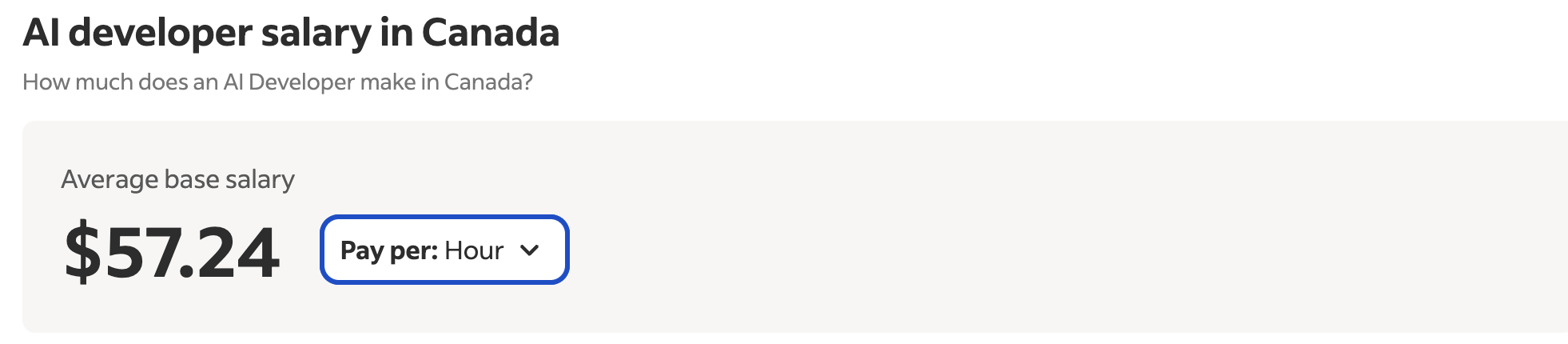
Talent.com indicates that the AI developer average salary is $110,018 annually, which equals an AI developer salary per month of $9,158 or $56.42 per hour.
Junior AI specialists earn $78,159 annually, whereas senior engineers earn 111.11% more — $165,000 annually.
AI Software Developer Salary in Australia
Australia’s artificial intelligence (AI) market will be worth US$315 billion by 2028. The Australian government regulates the application and implementation of AI technology across various industries, including healthcare, finance, agriculture, and retail. Multiple universities and organizations drive AI innovation and contribute to its nationwide adoption.
How much does AI engineer make in Australia? The average salary is $128,400, according to Jobicy.com.

An AI engineer starting salary is $89,880, and more experienced specialists earn $192,600.
AI Developer Salaries by Specialization

AI engineers perform various roles depending on their tech stack and their industry. Here is the average salary in the USA by specialization.
| Role | Junior | Middle | Senior |
|---|---|---|---|
| Machine Learning Engineer | $71,799 | $161,946 | $212,928 |
| Data Scientist | $64,212 | $124,726 | $154,374 |
| Robotics Engineer | $71,799 | $119,363 | $200,000 |
| Computer Vision Engineer | $140,043 | $169,419 | $208,000 |
| NLP Engineer | $135,000 | $170,000 | $209,831 |
| AI Research Scientist | $107,500 | $130,117 | $173,000 |
| Neural Network Engineer | $89,000 | $109,040 | $133,500 |
| AI Product Manager | $92,500 | $159,405 | $197,000 |
* Salary data is sourced from indeed.com, talent.com, and ziprecruiter.com
Computer vision engineers have the highest starting salary of $140,043 annually. The lowest AI developer salary is offered to data scientists — $64,212 annually. Mid-level specialists earn from $109,040 to $170,000. A neural network engineer salary is the lowest on our list — $109,040. Computer vision and NLP engineers have the highest earnings: $169,419 and $170,000, respectively.
As for senior roles, machine learning engineers command the highest pay — $212,928 annually. Robotics engineers, computer vision specialists, and NLP engineers earn between $200,000 and $209,831. Experienced neural network engineers receive the lowest compensation — $133,500.
AI Developer Hubs Report
The Best AI Developer Hubs: An Overview of Seven Locations and Salary Benchmarks Delivered by Qubit Labs.
Download
Emerging Trends Impacting AI Developer Salaries
The salary for an AI engineer depends on the global economy. The globa businesses’ increased use of AI drives the demand for qualified talent and increases investment in software development. Machine learning, deep learning, and data science are some of the most in-demand skills for AI professionals, as they significantly enhance their pay scale. Here is a brief overview of the prominent trends leading to premium wages.
| Trend | In-Demand Skills | Salary Impact |
|---|---|---|
| Increased Demand for Generative AI Expertise | Deep learning, NLP, Python, PyTorch, TensorFlow, prompt engineering, and computer vision. | Higher salaries for specialists proficient in large language models. |
| Rise of AI Ethics and Responsible AI Development | Proficiency in machine learning and algorithm development, knowledge of data privacy and security protocols, ethical AI standards, AI governance and policy frameworks, AI system testing and validation techniques, and bias mitigation. | AI compliance specialists will earn a premium. |
| Edge AI and On-Device AI | TensorFlow Lite, computer vision, edge computing, and model optimization. | Engineers skilled in on-device AI optimization will earn a premium. |
| Multimodal AI | TensorFlow, PyTorch, CNNS, NLP, speech & audio processing, and multimodal model architectures. | Specialists who develop AI models processing multiple data types will be in high demand. |
| AI for Science and Healthcare | Understanding healthcare systems; knowledge of compliance, data management, statistical analysis, and proficiency in ML/DL; mastery of Python, R, TensorFlow, PyTorch, AWS, and Azure; and knowledge of bioinformatics and genomics. | Biotech companies, research institutions, and startups will offer high salaries to specialists with relevant technical expertise. |
| Building AI Agents | Knowledge of Python, Java, and C++; proficiency in Pandas, NumPy, and SQL; and understanding of NLP. | Developers who can build autonomous AI agents will experience a significant salary boost. |
| AI & Gen AI in Cybersecurity | AI programming and development, data and security management, NLP, and security automation tools (SMAAT, SCM, NIPS, CrowdStrike Falcon, etc.). | The salary for artificial intelligence specialists with cybersecurity knowledge will be on the high end of the pay scale. |
Challenges in Hiring and Retaining AI Talent
The tech landscape is highly dynamic and competitive, contributing to intense competition for AI professionals. Businesses should use effective strategies to find and retain exceptional talent.
Limited Talent Pool
AI technology is evolving rapidly, so businesses are constantly seeking skilled AI developers. Local talent pools may be limited, and the salary expectations can be high.
The best option is to employ offshore developers. Our latest research shows that the primary reasons for hiring remote teams are accessing global expertise (74.3% of tech companies) and cost savings (82.9%). Collaborating with AI developers from cost-effective locations can help you use niche skills at competitive rates and speed up your time-to-market.
Qubit Labs understands the needs of businesses leveraging AI technology, and we know how to efficiently find the best AI engineers. We have built a dedicated team for an AI-enhanced customer engagement platform, enabling our clients to swiftly enhance existing solutions and build new features while maintaining a competitive edge.
Security and Confidentiality
Security and confidentiality are crucial for AI initiatives, as they often involve sensitive data and proprietary algorithms. To eliminate this issue, ensure all developers adhere to strict security protocols, use only secure communication methods, regularly verify compliance with rules, and implement robust data protection measures.
Retention Challenges
Retaining top-tier talent may be as challenging as attracting it. To address this issue, stick to the following strategies.
- Prioritize training and career development. AI employees should be equipped with the latest AI skills and tools, so organize internal courses, guarantee access to various workshops and seminars, and provide clear career advancement paths.
- Offer competitive compensation packages. If your budget allows, ensure salary and benefits meet the market standards. If you have budget constraints, offer non-monetary benefits such as remote work, flexible hours, manageable workloads, well-being programs, and a generous vacation policy. Strong retention strategies ensure you can work with offshore AI developers for years, driving innovation.
- Encourage open communication and productive teamwork to foster a collaborative environment where all professionals feel heard, connected, and committed to overall success.
Secure Top AI Talent with Qubit Labs
AI will be one of the leading technologies in the future, so AI engineer salaries will remain competitive. They will grow based on the latest industry advancements, increasing demand for niche expertise, and the ongoing development of AI-powered solutions.
Today, the USA leads the way with the highest AI engineer salary in the world — $147,524. Canada and Australia offer $129,850 and $128,400 to AI developers with 2–5 years of experience. Western Europe offers, on average, ~$100,000 to AI professionals, and Switzerland is the top-paying country in the region.
Eastern Europe offers more attractive offshore developer rates while maintaining superior quality. The average pay in major tech hubs is $48,800, approximately 67% less than in the USA. In Asia, India and Vietnam offer lower rates ($17,323 and $25,150) than Singapore, which offers AI engineers $106,922. In Latin America, the average AI engineer salary ranges from $18,547 in Bolivia to $58,075 in Mexico.
In the future, demand for skilled professionals with AI expertise and market competition will grow. Businesses should partner with a reliable outstaffing company to build a team that drives innovation now. Qubit Labs has the expertise to source top-tier talent to meet your business needs. Besides, we can conduct free salary research tailored to your requirements to help you make informed decisions.
Are you ready to attract top AI talent and revolutionize your industry? Book a free consultation call to learn how.