In 2026, React Native has solidified its position as a top choice for cross-platform mobile development, according to EurosHub. Powered by its modern architecture (TurboModules, Fabric, and JSI), React Native delivers near-native performance and significantly improved scalability. As TechReviewer states, roughly 1 in 10 apps on iOS and Android is built with or supported by React Native.
Our experience shows that in 2026, competition for React Native developers will intensify, and demand will still far outpace supply. What is an option then? IT staff augmentation can be useful if you prioritize transparency, efficiency, and optimal resource usage. By building a dedicated React Native team with Qubit Labs, our clients have reduced operational costs by up to 70% and brought products to market twice as fast.
When tech businesses hire React Native developers with us, the most frequently asked questions are:
- Where can I source React Native developers for mobile app development?
- What are IT outsourcing costs?
- Which engagement model should I choose?
- How do I effectively evaluate React Native engineers?
- What are the risks of hiring offshore React Native developers, and how can I mitigate them?
In this article, we’ll answer these questions, discuss where to find React Native developers to help bring your project to life, and share a step-by-step guide on how to hire dedicated React Native developers to avoid product stagnation, investor skepticism, and team burnout.
Why Hiring React Native Developers Is Harder Than It Looks
Quokka Labs states that React Native is still a perfect choice in 2026, as it enables faster MVP launches and ensures a consistent user experience across all platforms. Given its popularity, a large global talent pool, and well-defined roles, hiring React Native developers seems easy on paper. Still, in practice, it can be more complex than it initially appears.
Our clients face the following challenges:
- Surface-level familiarity instead of in-depth knowledge. Although many developers list React Native proficiency on their CVs, many lack expertise in bridging native modules and don’t have a track record of delivering solutions that perform consistently across iOS and Android at scale.
💡 Qubit Labs’ Tips: Screening should be performed by professional evaluators who can comprehensively assess technical depth to distinguish strong from exceptional. - Speed over quality. Businesses with a clear project scope and tight timelines typically want to fill seats fast, prioritizing availability over capability. This can lead to missed deadlines and poor product quality.
💡 Qubit Labs’ Tips: Even when React Native projects don’t wait, hire React Native app developers with the right tech stack and the necessary experience to avoid costly mistakes and maintain a competitive advantage. - Challenging passive candidate search. Supply vs. demand analysis from beBee indicates that in 2026, there are 2,561 React Native job listings but a limited pool of professionals with the required skill set. Also, the best candidates are senior professionals who do not monitor job boards, making it challenging to secure the right talent.
💡 Qubit Labs’ Tips: Reach passive candidates by contributing to innovative projects, participating in thought-provoking discussions, attending conferences, and leveraging personalized outreach strategies.
Offshore vs In-House vs Outsourcing Hiring
If you want to hire dedicated React Native app developers in a way that maximizes your benefits, then consider these three main models.
| Factor | Offshoring | In-House | Outsourcing |
|---|---|---|---|
| Cost | Up to 70% lower compared to local market rates. | High, including salaries, taxes, and benefits. | Fixed cost yet may include hidden fees. |
| Hiring speed | 2-4 weeks. | 6-14 weeks. | 2-4 weeks. |
| Talent pool | Access to global talent with the necessary skills. | Limited by a talent market. | Defined by a vendor, technical skills may vary. |
| Control | High; you hire a React Native development team that works under your guidance. | Complete; you manage your team directly and embed it in the organization’s culture. | Low; the vendor defines and manages all processes. |
| Scalability | High; you can ramp up resources when necessary without extra costs. | Low; all changes are costly and slow. | Medium; you should negotiate on contract terms to add or reduce resources. |
| Knowledge retention | High; crucial knowledge remains within your team. | Highest; all permanent employees have the required knowledge and are valuable assets. | Low; core knowledge sits with the vendor. |
| Best for | Scaling and filling skill gaps. | Long-term projects that require strict security compliance and deep cultural fit. | Defined, time-sensitive projects. |
| Where to hire a React Native developer | Specialized service providers with verified React Native track records. | LinkedIn, local job boards, university partnerships, internal referral programs, Slack communities, and React Native conferences. | Clutch.co, GoodFirms, Upwork, and agency directories. |
Best Hiring Strategy by Company Stage
There is no universally right model; everything depends on your current stage, budget, technical requirements, and long-term goals. Drawing from our experience, the recommended models for these company stages are the following:
- For MVPs, it’s better to hire a React Native developer who will quickly deliver a working product.
- For early growth, hire React Native programmers or build an offshore team to gain reliable development capacity without incurring hiring overhead.
- For Series A scaling, combine in-house product ownership with offshore coders to achieve cost-effective growth.
- For enterprise-grade solutions, build an in-house team for defining a strategic direction and making product decisions, and hire remote React Native developers when you need increased development capacity.
When Offshore React Native Development Makes Sense
Tech Insider states that React Native commands 35% of the cross-platform market and leads in job openings with 6,800 listings. React Native is an ideal choice for companies looking to build efficient, scalable, and future-ready digital products.
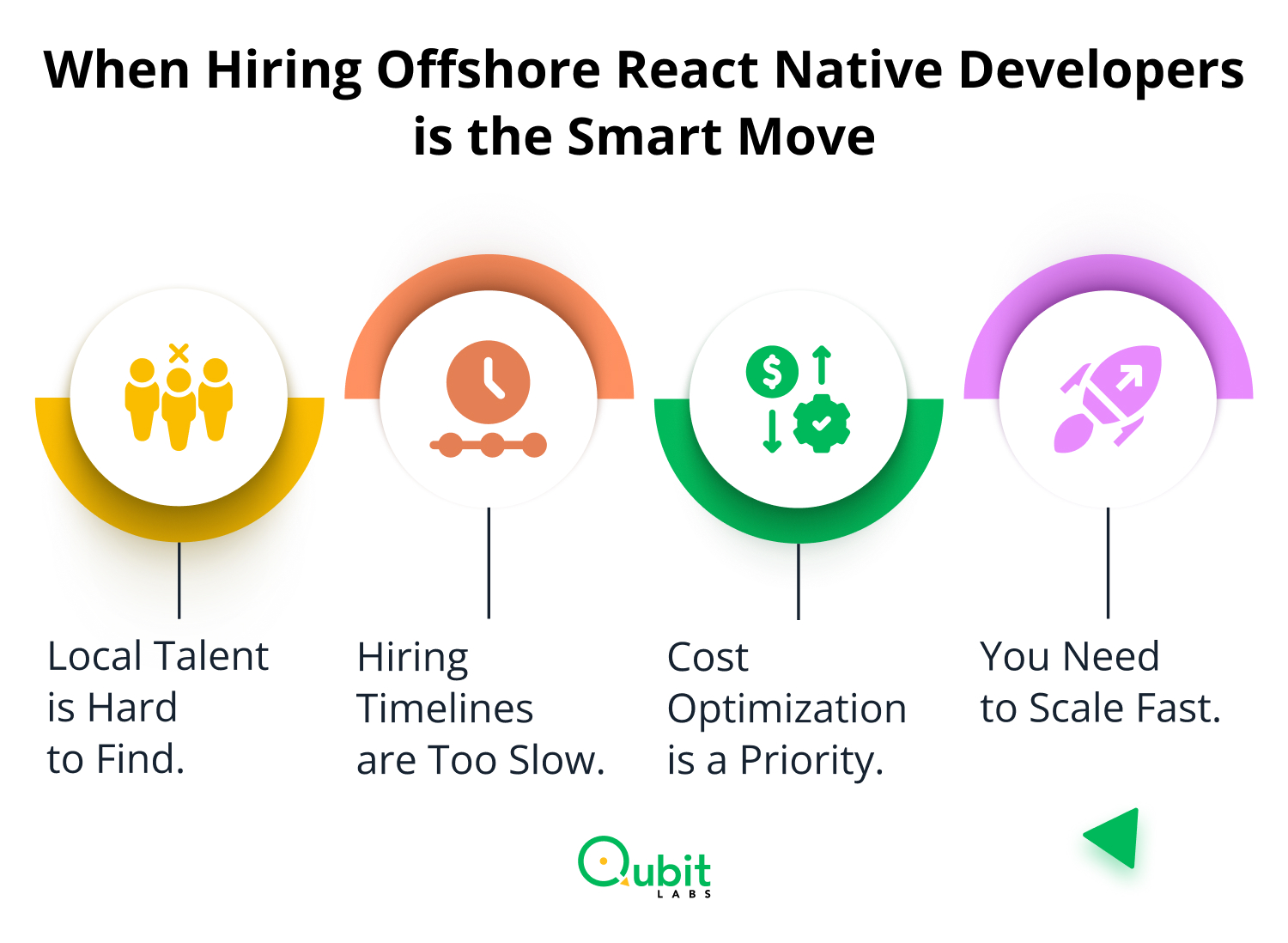
However, in a fast-moving market, React Native projects can’t afford delays. As a result, companies are increasingly focused on filling roles quickly, and in many cases, hiring offshore developers proves to be the most effective solution. In practice, hiring React Native engineers offshore makes the most sense when:
Your Local Talent Pool Is Limited
Oftentimes, your immediate market cannot supply the React Native depth your project demands. In this case, going global is a win-win option. The European Manufacturing Survey shows that about 13% of companies offshore due to a shortage of qualified local talent.
📖 Success story: Our client lacked the required expertise in Switzerland and found skilled React Native specialists in Ukraine within 3 weeks without disrupting business operations.
Hiring Timelines Don’t Match Your Delivery Schedule
When local recruitment takes months but your project launches in weeks, partnering with an offshore team is often the only practical path to delivering on time.
📖 Success story: Thanks to our vast talent pool and agile hiring strategy, we found React Native developers for a telecom company in less than 3 weeks, ensuring the client can implement all features on time and scale seamlessly in the future.
Cost Efficiency Is Your Priority
This factor is the primary motivation for approximately 70% of tech businesses, according to Abroad Works. Based on our work with clients, Poland, Romania, Moldova, Ukraine, and Bulgaria offer competitive rates and high-quality solutions. These countries have mature tech ecosystems, a perfect time zone alignment, and skilled React Native developers who work efficiently in remote settings.
📖 Success story: A renowned client in the edtech industry required niche skills for rapid expansion and collaborated with developers from Latin America, which led to poor results. Considered one of the leading staff augmentation companies in Eastern Europe, Qubit Labs has built a dedicated development team in the region and handled HR, administrative, and payroll matters, supporting seamless growth.
You Want to Scale Rapidly
If you hire the best React Native developers through a staff augmentation company, you can add verified React Native expertise in weeks and scale back just as efficiently when project demands shift.
📖 Success story: A U.S.-based startup required fast scaling, and Qubit Labs built a dedicated team in 2 weeks, ensuring fast and efficient operation.
Where to Hire Offshore React Native Developers
For businesses that want to hire React Native app developers efficiently and maintain secure, efficient collaboration, Eastern Europe is a top choice. Also, depending on requirements related to cultural and time zone alignment, some businesses choose Latin America and Asia as their top hiring locations. Here is what makes these regions sought after for tech companies, based on over 9 years of our experience.
| Factor | Eastern Europe | Latin America | Asia |
|---|---|---|---|
| Key tech hubs | Poland, Romania, Bulgaria, and Ukraine. | Brazil, Mexico, Colombia, and Argentina. | Vietnam, India, Indonesia, and the Philippines. |
| Talent pool | ~12,000 developers. | ~30,000 developers. | ~150,000 developers. |
| English proficiency | High and very high proficiency. | Low to high proficiency. | Low to high proficiency. |
| Time zone | CET / EET — 1 to 3 hours ahead of the UK, 6 to 9 hours ahead of the US East Coast. | UTC-3 to UTC-6. Perfect overlap with U.S. teams, 4 to 6 hours behind Western Europe. | GMT+7 to GMT+5:30. Limited overlap with US and European teams. |
| Pros | In-depth React Native knowledge, GDPR compliance, and perfect cultural alignment with Western teams. | A fast-growing talent base and perfect cultural and time zone alignment with U.S.-based teams. | A large talent pool and the most competitive rates worldwide. |
| Cost | Less competitive rates compared to Asia. | Senior talent is extremely expensive. | Time zone gaps and quality variance. |
React Native Developer Cost in 2026
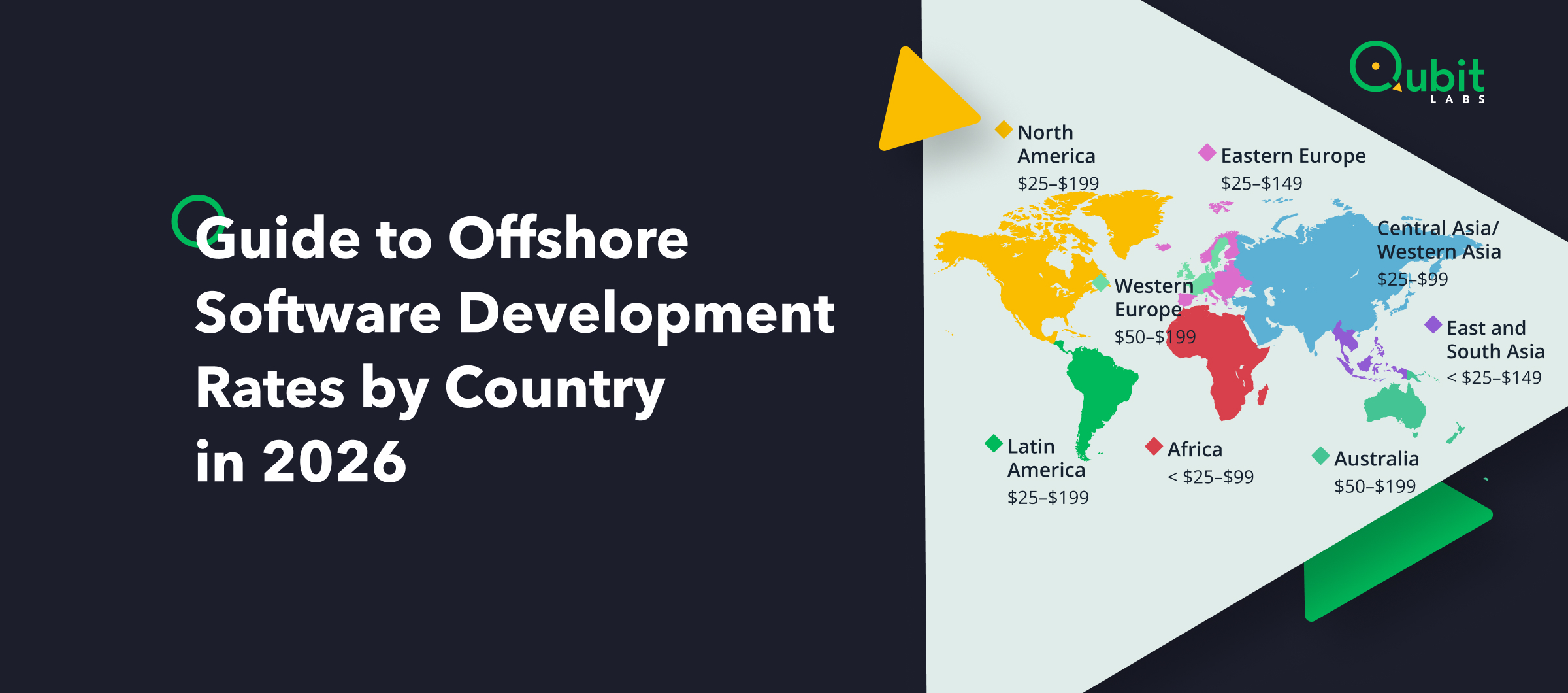
Here is an overview of the average software developer salaries and hourly rates across the best outsourcing regions.
| Region | Annual React Native Developer Salary (Range) | Hourly Rate |
|---|---|---|
| Eastern Europe | $20,110-$46,000 | $25-$99 |
| Latin America | $23,000-$28,750 | $25-$99 |
| Asia | $7,100-$17,250 | $25-$49 |
* Data is sourced from ziprecruiter.com, jobicy.com, glassdoor.com, and clutch.co
It’s essential to remember that the cost depends not just on rates but on how you structure the team, define requirements, and balance quality with speed.
Which region should you choose based on your location and project needs? With over 9 years of experience supporting 300+ companies, we’ve identified clear patterns that help determine the best region for your specific goals.
- Choose Eastern Europe if you focus on compliance and top-notch quality.
- Latin America is the best choice if you are based in the U.S. and require real-time collaboration.
- Asia suits cost-sensitive projects with clear requirements.
How to Hire and Evaluate React Native Developers
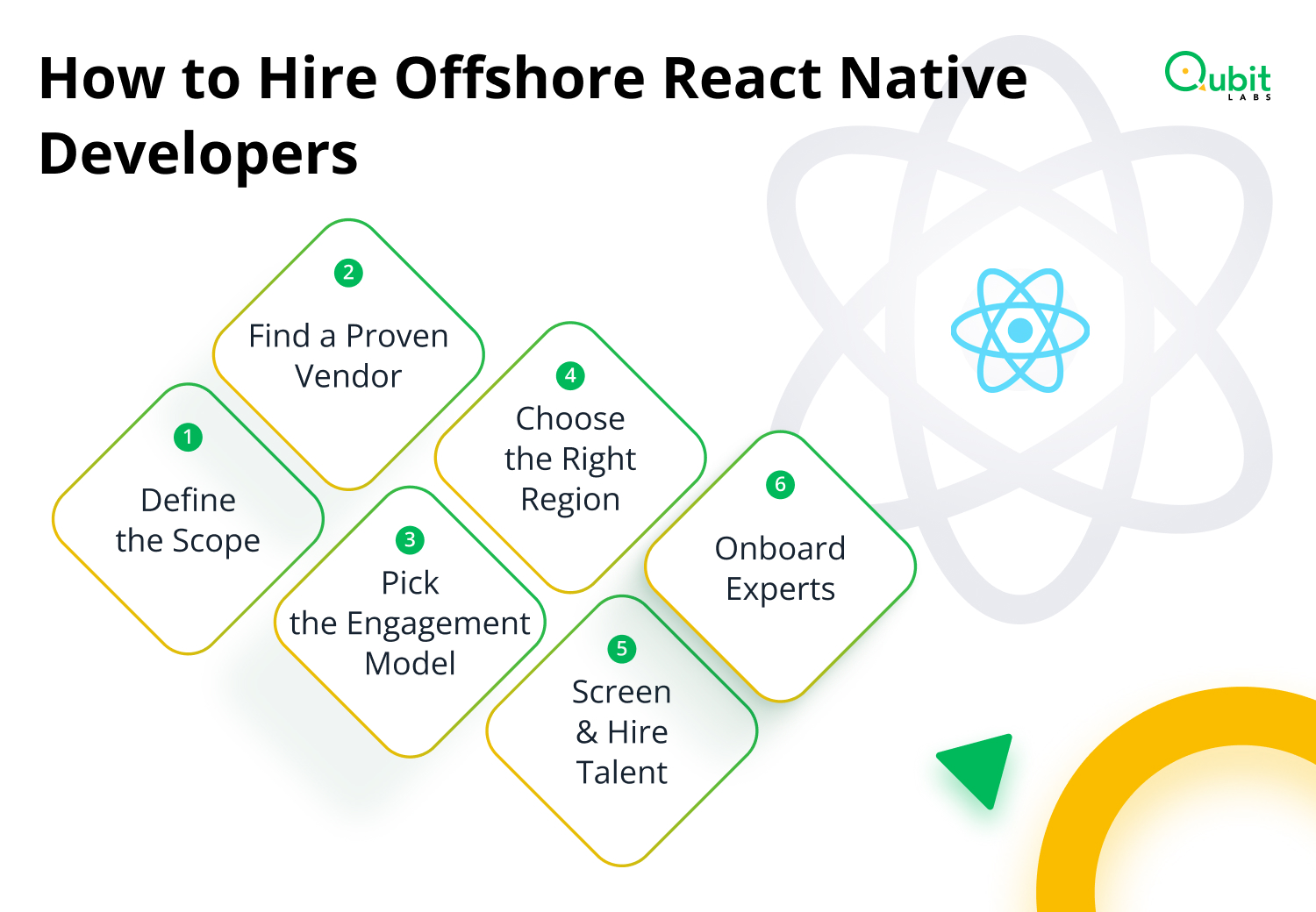
Qubit Labs boasts a client base of over 300 companies and more than 1,200 successful placements. Therefore, we know how to hire React Native engineers for building high-performing cross-platform applications. Leverage this proven hiring framework that ensures precise matching with your requirements and perfect cultural alignment.
1. Define Your Project Requirements
You must provide a detailed, specific job description that outlines your project requirements to attract the right candidate. Based on our hiring expertise, top-tier professionals have the following skills:
- Mastery of JavaScript (ES6+) for asynchronous programming and TypeScript for type-safe code.
- Proficiency in core React concepts, such as JSX, components, props, and hooks (useState, useEffect, useMemo).
- Expertise in state management using Redux, Zustand, and MobX.
- Foundational knowledge of Swift/Objective-C (iOS), Java/Kotlin (Android), RESTful APIs, GraphQL, and DevOps practices for optimized performance, back-end integration, and streamlined deployment.
2. Select a Reliable Vendor
Choosing a trustworthy partner can be challenging, as you should evaluate them against various criteria, assess their alignment with your long-term objectives, validate their experience, and then make your choice. To facilitate your selection process, here is a checklist of characteristics to evaluate before signing an agreement.
- Technical expertise of the provided developers.
Why it matters: Hands-on experience with the latest frameworks and tools, such as the JavaScript Interface (JSI), Expo & EAS, Tamagui, React Native Reanimated (v4), Zustand, Maestro, Sauce Labs, and TestMu AI guarantees stable delivery of enterprise-grade products. - Transparent vetting and screening processes.
Why it matters: Full visibility into these processes ensures high technical proficiency and cultural alignment of candidates. Check whether a vendor has a flexible hiring process that incorporates the steps and assignments you need, how it sources and vets programmers, and how long the process takes. - A track record of successful placements in your specific industry.
Why it matters: Domain expertise speeds up the hiring process, as the vendor knows the required tech stacks and role expectations, understands how success looks in your industry, reduces the risk of costly skill or context mismatches, and has a strong understanding of your product concept. - Clear communication standards and timezone compatibility.
Why it matters: According to the Project Management Institute (PMI) Study, 56% of project failures worldwide are linked to poor communication. Therefore, it’s crucial to ensure that a potential partner has strong project management skills, guarantees time zone alignment, conducts regular standups, and provides feedback reports to eliminate collaboration breakdowns. - Transparent cost structure.
Why it matters: Our partnership with over 300 clients proves that cost transparency builds trust, accountability, and ethical practices. It guarantees budget predictability, crucial for fast-growing companies. To assess it, check the company’s value proposition and whether it specifies the scope and cost of its services, as well as developers’ salaries across various countries.
3. Choose the Right Hiring Model
In real-world projects, the appropriate engagement model, aligned with your budget and requirements, plays a critical role in controlling costs, ensuring predictable delivery, and maintaining product quality at scale. Here are three options you can consider based on our real-world experience.
- Staff augmentation is perfect for bridging existing skill gaps in your existing team and meeting tight deadlines.
Pros: Full control over development and delivery, knowledge ownership of your team, and exceptional flexibility.
Best for: Feature launches and product sprints. - Dedicated teams typically consist of React Native developers, QA engineers, and project managers and serve as an extension of your in-house team, working exclusively on your product.
Pros: Fast delivery, strong team integration, high retention, and cost predictability.
Best for: Ongoing product development and startup scaling. - Project-based outsourcing means hiring a vendor that takes full ownership of a specific project.
Pros: Minimal administrative burden, predictable costs, and a strong focus on your internal team of core processes.
Best for: One-time builds, MVPs, and other well-defined projects.
4. Select the Best Location
It is crucial to choose a hiring destination that fits your budget and offers substantial expertise in React Native, favorable labor regulations, affordable tax rates, English proficiency, and cultural fit. As our expertise shows, Poland and Romania stand out as leading React Native hubs with large, mature talent ecosystems, favorable tax regimes, and alignment with Western business practices.
- Poland
💪 Specialization: Enterprise mobile apps and large-scale cross-platform development.
🔠 EF English Proficiency: #15 out of 123. - Romania
💪 Specialization: Fintech and enterprise solutions, and web-to-mobile development.
🔠 EF English Proficiency: #11 out of 123.
Qubit Labs’ experience:
An innovative company in the MaaS industry needed to scale rapidly and required deep expertise in React Native, Node.js, and DevOps. With a clear location preference, they turned to Qubit Labs to build a dedicated development team in Eastern Europe.
Recognized as a leading talent provider in Eastern Europe, Qubit Labs assembled a highly skilled and productive team in Ukraine, tailored to the client’s technical and business needs.
Impressed by the quality of our engineers and delivery, the company expanded the team to 13+ specialists, building a long-term partnership that has successfully evolved over five years.
5. Evaluate and Hire Developers
Carefully assess the best React Native developer profiles provided by your staffing partner and select the best candidates who proceed to the interview stage. Then evaluate technical proficiency and soft skills using time-tested strategies from Qubit Labs.
- Conduct live coding assessments via CodeSandbox or StackBlitz helps you evaluate how clean the code is, how a developer works in real-world conditions, and how they communicate technical decisions.
- Incorporate multiple-choice questions (MCQs) to evaluate how a specialist understands the fundamentals of the React Native concepts and language features.
- Add project-specific questions to assess expertise in areas such as third-party library integration, state management (e.g., Redux and MobX), and performance optimization.
- Ask language-specific questions to assess a candidate’s understanding of ES6 features, React Native architecture, and their ability to work with APIs, state management tools like Redux, and navigation libraries such as React Navigation.
- If you want to tell if a React Native developer is actually a senior, ensure your questions and test assignments target specific concepts, such as their ability to write custom modules in Swift/Objective-C (iOS) or Kotlin/Java (Android), knowledge of TurboModules, JSI, and the Fabric renderer, and capability to diagnose and fix complex problems in Xcode or Android Studio, including those outside the JavaScript layer.
- Assess soft skills such as communication, collaboration, and adaptability, as well as how well candidates align with your team’s culture. This can be evaluated through behavioral interviews, references, and discussions about work styles.
Onboard Engineers
After you have signed an agreement with a reputable vendor and chosen your React Native developers, it’s important to integrate them seamlessly into your workflows. For smooth onboarding and an enjoyable candidate experience, you can use Qubit Labs’ strategies:
- Treat your new hires as part of your team.
💡 Tips: Include daily standups and retrospectives to foster productive collaboration. - Introduce the required tools and workflows from the start.
💡 Tips: Ensure all team members use the same communication and project management tools to avoid confusion. - Assign a tech lead.
💡 Tips: A tech lead provides the required guidance and eliminates decision bottlenecks. - Ensure time zone overlap.
💡 Tips: Organize a 2-4-hour overlap to enable real-time collaboration and streamline decision-making. - Foster team culture and trust.
💡 Tips: Create an “us” mindset, celebrate wins, and acknowledge the developers’ contributions.
Why Companies Choose Qubit Labs
In conclusion, hiring an offshore React Native developer can be an excellent choice for businesses looking to create high-quality cross-platform apps with a native feel. However, it’s essential to hire experienced professionals who can deliver high-quality code that meets your project’s requirements.
Partnering with a professional company like Qubit Labs, which specializes in building dedicated software development teams, can be a wise choice. We have over 300 companies in our client base, hire React Native developers in over 18 countries, and boast a talent pool of over 100,000 professionals with Native platform mastery, strategic thinking, and perfect flexibility. We offer:
- Top-notch React Native expertise not on paper but in practice.
- Complete HR, administrative, and payroll support throughout the engagement to keep core processes running smoothly and ensure your developers are motivated.
- Transparent and straightforward pricing without unexpected fees, contributing to your budget predictability.
- Flexible contracts that cater to different budget sizes and requirements.
- Efficient recruitment tailored to your request with a fast turnaround in sourcing qualified candidates.
We assemble a team of experienced developers from top tech hubs who can help you create a scalable, high-performing app. Schedule a call with our team to get more details.