Globalization, IT talent shortages, AI, and rapid technological advancements are pushing companies to become more agile and competitive, and to invest heavily in digital transformation and innovation. Gartner projects global IT spending to grow by 10.8% in 2026, reaching $6.15 trillion.
One of the most effective strategies for companies to keep pace with global breakthroughs is offshore outsourcing. Google, IBM, and Microsoft are the best offshoring examples. These tech giants reduce operational costs by up to 70% by collaborating with offshore companies in Eastern Europe.
I’m Iva Kozlovska, co-founder and CEO of Qubit Labs. The company offers end-to-end staff augmentation solutions to Fortune 100 companies and aspiring startups. With over 9 years of experience and 1,200+ successful placements, we guarantee fast recruiting, secure, compliant collaboration, seamless HR, payroll, and administrative support, and smooth team scaling to support your sustainable growth.
In this article, we’ll share our insights on successful offshore outsourcing examples, outline the key strategies of companies that use offshoring, and explain why some companies fail when implementing this strategy. By learning from both successes and failures, you can apply valuable insights to avoid missed deadlines and budget overruns.
Key Takeaways
- Offshoring is the relocation of software development, customer support, financial operations, manufacturing operations, administrative tasks, and other business processes to another country.
- Offshore outsourcing helps companies tap into a specialized talent pool, reduce costs, and boost operational efficiency.
- This strategy is a wise move if you need to scale fast, achieve 24/7 support, and reduce operational expenses.
- Successful offshoring examples include WhatsApp, Google, Netflix, Slack, Canva, and more.
- Clear scope, transparent collaboration, the right location, strong talent quality, clear contracts, and cultural affinity ensure an effective offshoring strategy.
- In the future, outsourcing will focus on AI-driven services, specialized roles, and hybrid collaboration models.
- Qubit Labs enables successful offshoring through access to high-quality talent, transparent collaboration, flexible, compliant contracts, and up to 70% cost savings.
What Is Offshoring and How It Works
“Offshoring is a strategy of relocating business operations and IT processes to other countries to reduce costs, access specialized talent, scale teams efficiently, enter new markets, and accelerate product development,” says Iva Kozlovska, CEO of Qubit Labs.
Offshore software development is one of the most sought-after outsourcing strategies, but it has unique benefits. Here is a brief comparison of offshoring and outsourcing, offshore outsourcing pros and cons, and successful offshoring examples.
| Criterion | Offshoring | Outsourcing |
|---|---|---|
| Definition | Relocating business functions to a different country. | Delegating work to a third-party service provider, either domestically or abroad. |
| Delivery management | Your in-house team. | Vendor’s employees. |
| Savings | Up to 70% on labor vs. the home country. | Varies; typically 20-50%. |
| Control level | High. You manage processes and culture. | Low. Governed by contracts. |
| Customization and scalability | High. You design the team structure and scale it efficiently. | Low. The vendor’s capabilities limit you. |
| Pros | Vast talent pools, significant cost savings, 24/7 coverage, and complete cost and development control. | Specialized skills, fast time-to-market, and the ability to focus on core operations. |
| Cons | Cultural, language, and time zone barriers. | Hidden costs and quality inconsistencies. |
| Real-world examples | Google has an engineering hub in Poland. | IBM outsources its IT infrastructure. |
Simple Offshoring Examples to Understand the Model
In 2026, offshoring remains a key trend, with projections that third-party IT services could reach $1.219T by 2030. To help you better understand the model, here are some examples of outsourcing.
1. A U.S. bank moves its customer support services to LATAM.
- In-house team: Manages strategy, compliance, and customer experience standards.
- Outsourced team: Answers the calls, resolves customer queries, and delegates complex tasks to the in-house team.
- Result: 27/4 shifts, up to 70% lower wages.
2. An automotive company in Western Europe relocates manufacturing to Asia.
- In-house team: Handles design, IP, compliance, and final assembly.
- Outsourced team: Assembles high-volume parts and manages pressing, stamping, and welding.
- Result: ~60% lower manufacturing costs, increased output by 40% without growing local headcount.
3. A Western European insurance software firm hires software developers in Poland.
- In-house team: Defines all features, makes architectural decisions, and conducts code reviews.
- Outsourced team: Builds features, conducts testing, and ships code.
- Result: Productive collaboration due to perfect time zone and cultural alignment, and up to 60% savings on operational costs.
Types of Offshoring
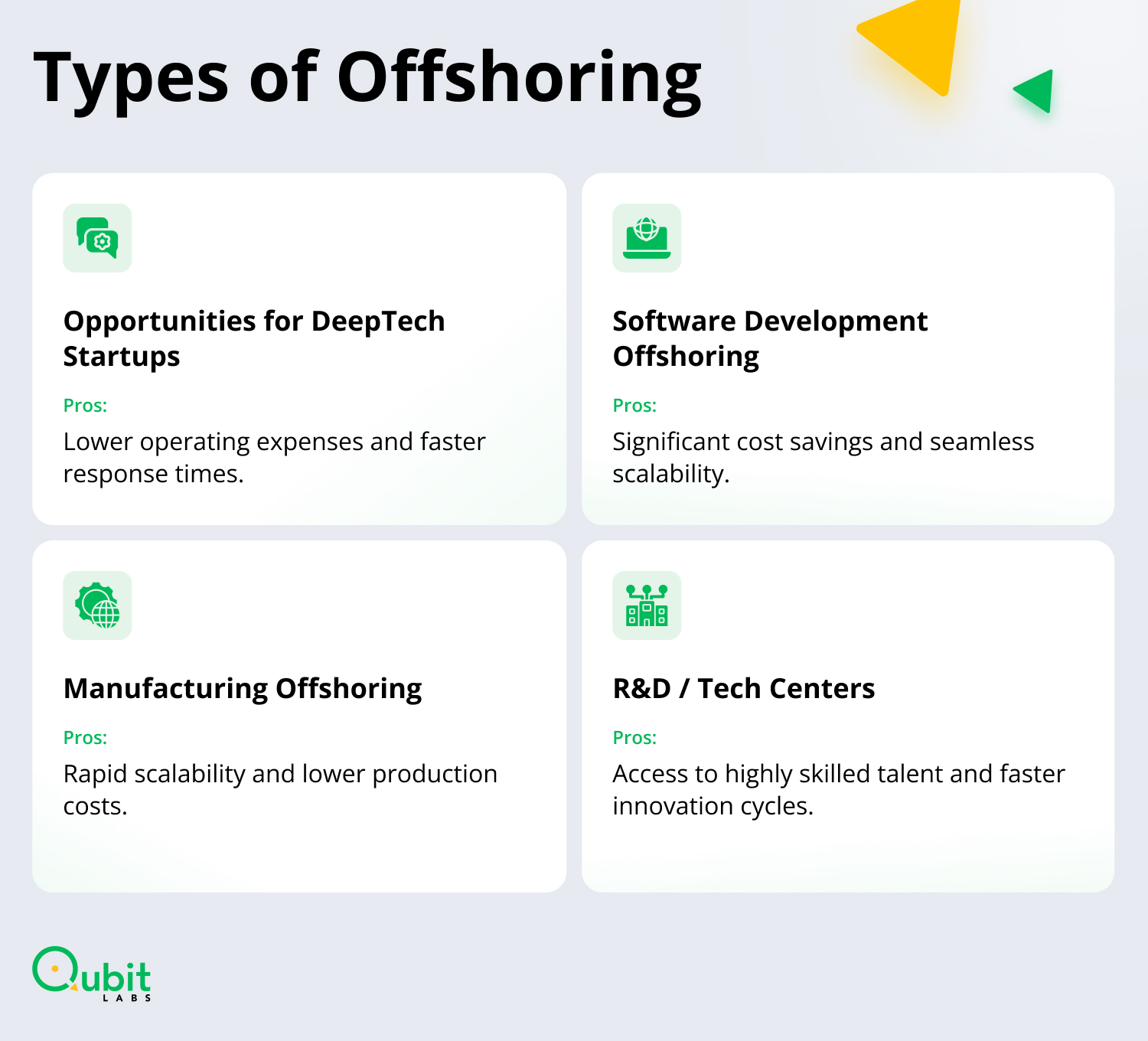
66% of U.S. companies outsource at least one business function, according to Zippia. Businesses choose various offshoring models based on their requirements. Qubit Labs will highlight the most popular ones drawn from our customers’ success stories.
Customer Support Offshoring
The most common offshoring example is relocating customer support operations to a country with lower labor rates and employing dedicated offshore staff.
- When to use: High-volume support interactions across different time zones and meeting seasonal spikes without expanding an in-house team.
- Pros: 24/7 customer service coverage, reduced operational costs, and improved response times.
Software Development Offshoring
It is a send-it-over model that involves hiring offshore software developers to handle development, testing, and maintenance while remaining under your direct management.
- When to use: Limited engineering capacity, skill shortages, and the need for around-the-clock streamlined development.
- Pros: Significant cost savings, IP ownership, and strong scalability.
Manufacturing Offshoring
A company outsources production, such as welding, stamping, and assembly, to offshore facilities while maintaining operational oversight and quality standards.
- When to use: The need for lower production costs, scalable manufacturing capacity, and high-quality, standardized processes.
- Pros: Fast scaling, improved operational efficiency, and reduced production expenses.
R&D / Tech Centers
A firm sets up an R&D center in an offshore country and staffs it with engineers and researchers working on proprietary products and innovation initiatives.
- When to use: The need for niche skills, academic ecosystems, and favorable government and tax initiatives.
- Pros: Access to top-tier talent, accelerated innovation, and long-term R&D scalability.
Real Offshoring Examples from Global Companies

SQ Magazine reports that outsourcing IT operations can cut costs by up to 85%. Qubit Labs’ experience shows that successful offshoring companies can save up to 70% by building dedicated teams in Eastern Europe while maintaining full development and cost control.
These examples of offshoring by tech giants and Qubit Labs’ clients demonstrate the advantages of this approach.
WhatsApp rapidly grew into one of the world’s most widely used messaging apps and was eventually acquired by Facebook for $19 billion in 2014.
- What they offshored: Design and mobile application development.
- Where: Eastern Europe.
- Why: To focus on core product stability and customer experience, reduce internal workload, and optimize resources.
- Result: An external vendor played a key role in improving product performance and scalability, enabling rapid user growth.
- Key takeaway: Prioritizing core features while outsourcing non-essential development work can help accelerate product growth. WhatsApp gained the trust of users who valued dependability above all else by avoiding feature clutter and providing best-in-class messaging performance.
Google collaborates with offshoring companies to build offshore development centers, scale product delivery, and enhance innovation.
- What they offshored: Software engineering, cloud engineering, AI, research and development, and product engineering.
- Where: India.
- Why: To streamline the growth of global products, accelerate development lifecycles with specialized skills, and contribute to AI/ML research.
- Result: Google stays at the frontier of AI development, expanding capabilities and delivering new features efficiently with the help of offshore employees.
- Key takeaway: A deeply integrated offshore workforce with solid engineering and research capabilities helped Google significantly streamline core product development and drive global innovation.
Netflix
Netflix is an example of offshoring. Thanks to tax offshoring, R&D outsourcing, and content production offshoring, it rapidly expanded into international markets.
- What they offshored: Content production and marketing support.
- Where: Latin America.
- Why: To adapt content to local audiences and support the platform’s rapid growth.
- Result: Netflix built a strong regional subscriber base, which is projected to reach 52.3 million subscribers in Latin America by 2027, according to Omdia, and became a leading streaming service in the region.
- Key takeaway: Local expertise and culturally relevant production are crucial for scaling digital products in a specific market.
The Open University
This edtech company, one of Qubit Labs’ clients, developed CORE, one of the world’s largest open-access research platforms, with a collection of 409 million papers.
- What they offshored: Software development.
- Where: Eastern Europe.
- Why: To support the platform’s rapid growth and optimize resources.
- Result: Offshore developers ensured scalable growth and contributed to a 58% reduction on costs.
- Key takeaway: Partnering with a reliable offshoring company can significantly improve scalability while reducing operational costs.
Petr Knoth, Founder & Head of CORE, says:
“They integrate seamlessly with the internal team, communicate clearly, and always find ways to improve. They took on the requirements and quickly identified an appropriate list of qualified candidates for the role. Their efforts paid off within a short matter of time as they put together a list of potential leads. The communications and the workflow between us were simply amazing. The team communicated extremely effectively, always keeping relevant people up to date and never wasting any time.”
Canva
Canva is an offshore company example that leverages offshoring to the Philippines to reduce costs, access unique expertise, and scale faster.
- What they offshored: Customer support, design operations, and back-office functions.
- Where: The Philippines and Southeast Asia.
- Why: To access specialized skills, accelerate innovation, and scale more quickly.
- Result: Offshoring these operations helped the company reduce costs, drive innovation, and achieve a $49 billion valuation, as reported by Forbes.
- Key takeaway: Offshoring streamlines innovation and promotes global expansion when paired with a culturally aligned talent market.
Slack
Slack, a leading productivity tool with over 42 million active users, required specialized expertise for software development and design.
- What they offshored: Software development, product engineering, and design support.
- Where: Eastern Europe and Southeast Asia.
- Why: To fill specialized skill gaps and speed up product development while maintaining cost efficiency.
- Result: Slack swiftly introduced new features, improved performance, enhanced stability, and experienced faster growth, reaching 79 million active monthly users in 2025.
- Key takeaway: Filling skill gaps can significantly enhance innovation, and partnering with specialists in lower-cost regions can streamline development without compromising quality.
Wise
This global fintech platform enables fast, low-cost international money transfers and boasts over 15.6 million active users, according to its annual report.
- What they offshored: Software development and customer support.
- Where: Multiple offshore locations.
- Why: To maintain low transfer fees while ensuring high-quality customer support and improved engineering capacity.
- Result: Wise improved efficiency and maintained competitive pricing for its users.
- Key takeaway: Outsourcing software development and other services to countries with low labor costs allows companies to balance cost efficiency with high service quality.
Brain Changer
Brain Changer is a telemedicine startup offering a science-based pain management platform for people living with chronic pain.
- What they offshored: Software development.
- Where: Central Asia.
- Why: To build secure APIs, integrate databases, and support product development.
- Result: With a highly skilled ASP.NET developer, the company improved team productivity and developed the necessary digital solution.
- Key takeaway: Offshore talent can significantly streamline development and improve the overall team’s performance.
Failed Offshoring Examples and Lessons Learned

Although offshoring is a win-win strategy for businesses across different sectors, it’s not a silver bullet.
“Our experience shows that while choosing the right location is important, selecting the right offshoring model is even more critical. When companies need scalable engineering capacity and delivery ownership, project-based outsourcing is often the best option,” says Iva Kozlovska, CEO of Qubit Labs.
What is an example of offshoring that went bad, and what were the underlying reasons? Let’s find out.
Dell
This tech giant, with a current enterprise value of 189.32 billion, has decided to streamline its business operations by relocating its customer service and technical support centers to India.
- What went wrong: The company faced customer dissatisfaction. Eventually, Dell brought these operations back to the U.S. to restore service quality.
- Why: The offshoring strategy failed because of cultural differences, communication barriers, and inconsistent customer service standards.
- Lesson: Ignoring cultural fit, English proficiency, and expertise when selecting an offshoring destination can compromise quality, delivery standards, and customer satisfaction.
Mobile Game Publisher
One of Qubit Labs’ clients, a mobile game development studio, needed Unity developers to develop cost-efficient games and chose India as the destination.
- What went wrong: The collaboration became inefficient due to missed deadlines, delayed decision-making, communication barriers, and inconsistent quality of delivery.
- Why: Time zone differences limited real-time collaboration, and communication misalignment slowed development.
- Lesson: For successful cooperation, it’s essential to assess the cultural and communication compatibility of offshore specialists, leverage practical project management tools, and prioritize both soft skills and technical expertise.
Homejoy
It was an online marketplace that matched local house cleaners with homeowners. To serve more countries and cities, the company decided to outsource IT support, web development, and customer service.
- What went wrong: Inconsistent quality, poor support, and a lack of commitment negatively impacted the brand’s reputation and customer retention. Eventually, these factors became additional reasons for the company’s shutdown.
- Why: The outsourced teams were not properly aligned with the company’s service expectations, lacked proper training, and operated without sufficient oversight.
- Lesson: Companies should provide comprehensive training for offshore teams and establish clear quality-control measures to ensure consistency.
Why Offshoring Works (Key Success Factors)
Our experience shows that successful examples of offshore companies are those that adopt a holistic approach, conduct thorough requirements analysis, clearly define project scope, and ensure strong governance with full transparency. Here are the core factors you shouldn’t ignore if you choose between nearshoring vs offshoring and want to make your offshoring strategy a success.
1. Clear Goals and Scope
TaskFino states that 35% of project failures are linked to issues in requirements gathering. Therefore, for clear deliverables, well-defined objectives are crucial.
Why it matters: Goal alignment and timely execution.
What happens if it’s ignored: Scope creep and missed deadlines.
2. Right Location
Our clients’ experience shows that choosing the right location, aligned with their budget and goals, guarantees a 50% success rate.
Why it matters: Access to specialized skills, tax incentives, and productive collaboration.
What happens if it’s ignored: Skill mismatches, time zone friction, and high management overhead.

3. Strong Communication & Cultural Alignment
Smooth communication and cultural affinity are essential in offshoring to ensure efficient collaboration and smooth project execution.
Why it matters: Effective cross-team collaboration and fast decision-making.
What happens if it’s ignored: Misunderstandings, project delays, and lower-quality outcomes.
4. Access to the Required Technical Expertise
In our experience, employing professionals with the necessary domain expertise and infrastructure streamlines development and helps avoid costly mistakes.
Why it matters: Efficient development, streamlined innovation, and high-quality deliverables.
What happens if it’s ignored: Rework, project stagnation, technical issues, and the loss of a competitive edge.
Best Countries for Offshoring in 2026
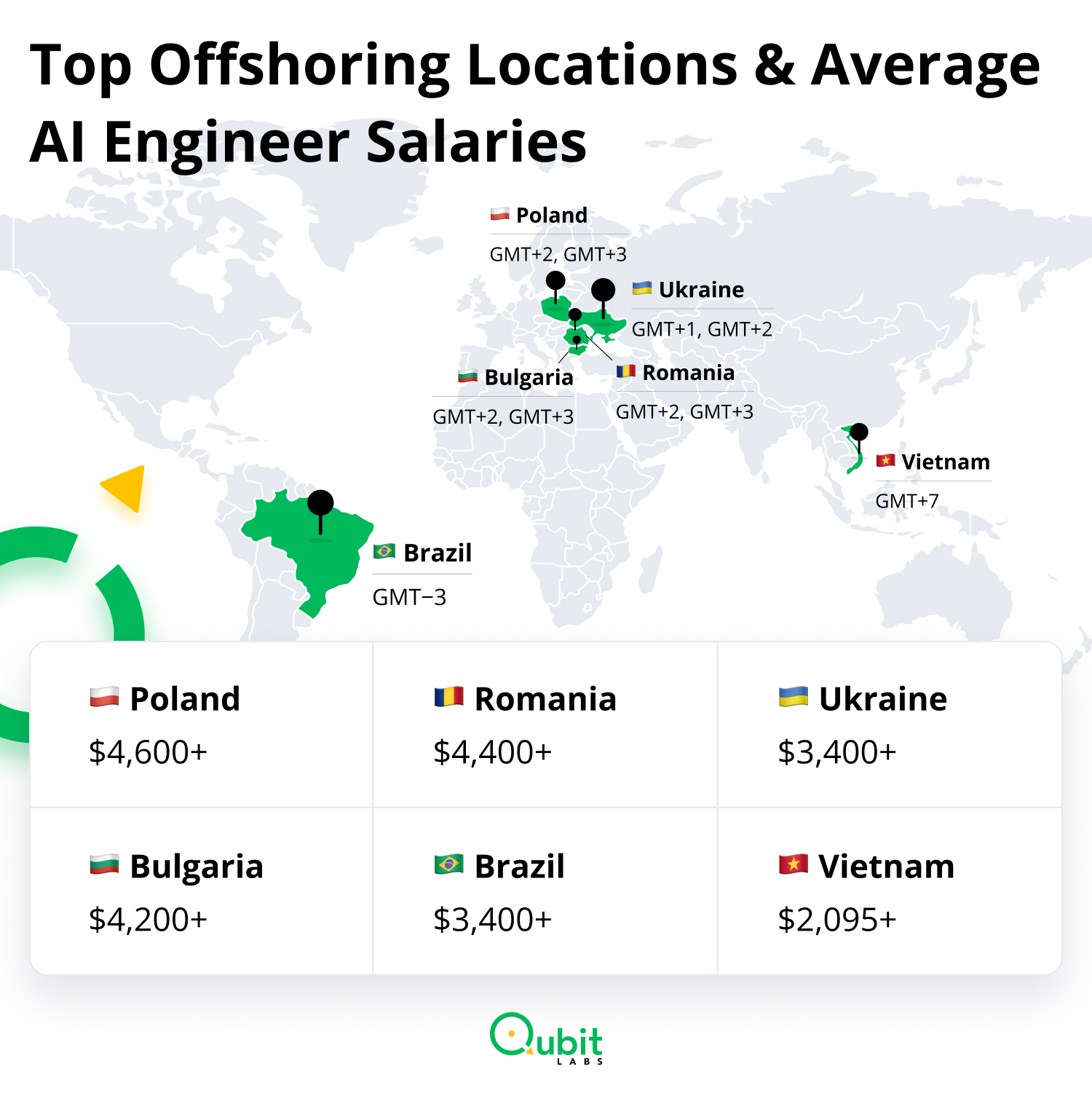
Based on our hiring expertise, Eastern Europe is the most popular offshoring location. It has a talent pool of over 1.2 million software engineers and a well-developed IT services market valued at $15.05 billion in 2025, according to Statista. In addition, Latin America and Asia are popular destinations due to attractive offshore software development rates and skilled specialists.
Eastern Europe
In addition to vast technical proficiency and large talent pools, this region offers strong security measures and IP protection, as strict European laws govern contracts and payments.
- Top hubs: Poland, Ukraine, Moldova, Bulgaria, and Moldova.
- Advantages: Strong STEM education, competitive costs, time zone alignment, high English proficiency, and strong cultural and business compatibility.
- Best for: Building software development teams for long-term projects in the fintech, SaaS, and mobile industries.
- Qubit Labs’ insights: This region is ideal for projects that require strong AI and cybersecurity expertise. However, rising salaries in recent months have made Romania and Poland less cost-effective, though they remain significantly cheaper than U.S. rates.
Latin America
It is a leading nearshoring destination for the USA due to a strong educational infrastructure, time zone alignment, and cultural similarities with Latin American countries.
- Top hubs: Brazil, Mexico, Argentina, and Colombia.
- Advantages: Strong AI engineering talent, multilingual workforce, and a strong startup ecosystem.
- Best for: Nearshore software development, startup projects across various domains, and AI/ML initiatives.
- Qubit Labs’ insights: Latin America offers highly specialized AI roles, but in some countries, markets are less mature, which can influence product quality.
Asia
Asia boasts a dynamic talent pool of 1.3 million developers, characterized by robust technical expertise, high English proficiency, and strong educational backgrounds.
- Top hubs: Vietnam, Philippines, Indonesia, and Malaysia.
- Advantages: Large tech talent pool, strong technical expertise, strong government support, and a well-established outsourcing ecosystem.
- Best for: Cost-efficient software development (AI, back-end, QA) and projects prioritizing high scalability.
- Qubit Labs’ insights: The region offers cost-efficient software outsourcing; however, for niche skills such as AI, hubs should be evaluated more carefully, as this exceptional talent is concentrated in higher-cost countries like Singapore.
| Factor | Eastern Europe | Latin America | Asia |
|---|---|---|---|
| Key skills | AWS, Azure, Python, Django, Java, JavaScript, PHP, C#, React, Angular, Node.js, and .NET. | JavaScript, Python, Java, C#, PHP, React, Angular, .NET, and Node.js. | Python, Java, JavaScript, React, PHP, Node.js, and .NET. |
| Time zone | GMT +1, GMT+2. | GMT-3 to GMT-8. | GMT+6:30, GMT+7, GMT+8, GMT+9. |
| IT infrastructure | Stable and mature. | Strong only in major hubs. | Strong in established markets and uneven in emerging hubs. |
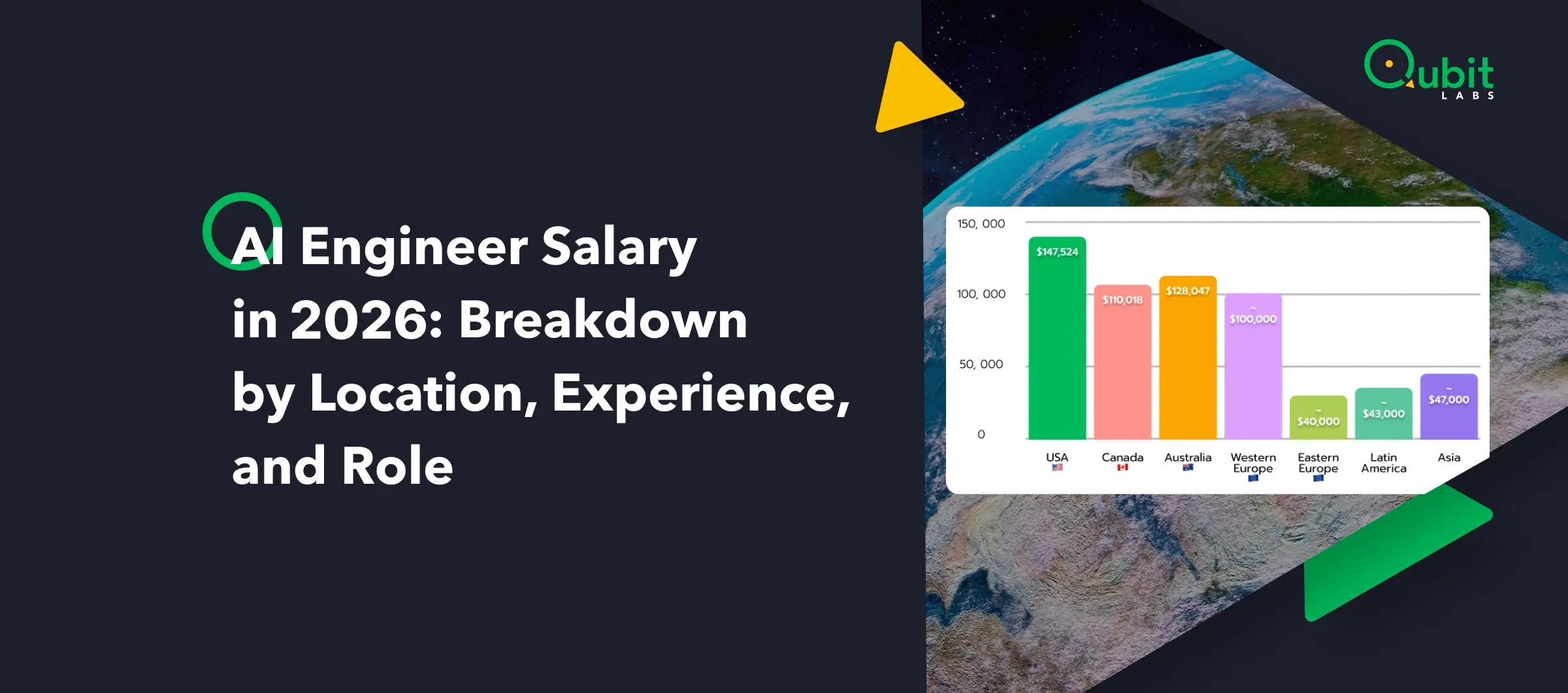
| Average AI engineer salary range | $3,100-$4,600 per month. | $3,400-$4,800 per month. | $1,400-$2,100 per month. |
| Top countries | Poland, Romania, Ukraine, Bulgaria, and Moldova. | Brazil, Argentina, Colombia, and Mexico. | Malaysia, Vietnam, Indonesia, and the Philippines. |
When Should You Use Offshoring?
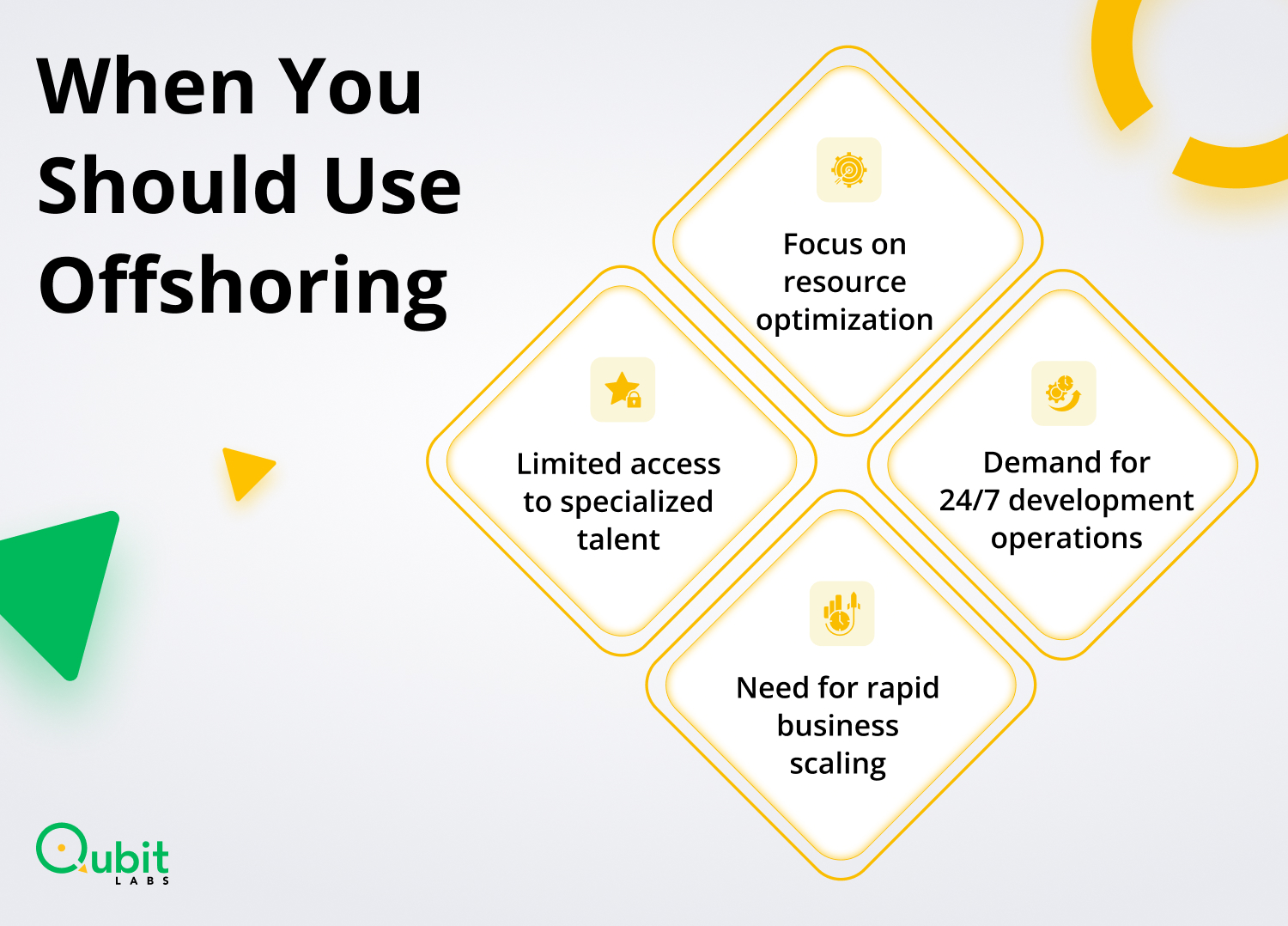
Microsoft, Amazon, Google, and Apple are prominent examples of offshore outsourcing. They reap all the benefits of offshoring to maintain cost-efficient production and large-scale software development. But when is this option the right choice? Qubit Labs will share its insights.
You Lack Skilled Talent
About 2/3 of companies report hiring delays due to skill gaps, according to the World Business Outlook. Offshoring helps you tap into a global pool of specialized expertise, keeping your development running smoothly.
Qubit Labs’ success story: A client in the logistics industry built a dedicated development team with specialized PHP expertise, streamlining development by 42% and making meaningful contributions from day one.
You Plan to Scale Rapidly
Based on our hiring experience, startups use outsourcing to access developers more quickly and avoid hiring delays that can slow product launches. It is especially relevant amid the AI talent shortage, which is a top challenge for 94% of CEOs globally, according to Forbes.
Qubit Labs’ success story: An ambitious U.S.-based startup in the telecom industry employed an offshore Node.js programmer who supported the rapid growth of a 3D video platform and improved its performance by 47%.
You Want to Optimize Resources
Cost-efficiency is one of the key drivers for offshoring. A survey conducted by Qubit Labs shows that 82.9% of tech businesses hire offshore teams for cost efficiency. At the same time, these firms do not compromise quality or development speed.
Qubit Labs’ success story: A client in the e-commerce industry built a team of Magento and Shopify developers who improved functionality and performance, achieving a 43% reduction in operational costs.
You Need 24/7 Development
By leveraging teams across different time zones, businesses can accelerate their delivery cycles and ensure continuous progress. Besides, offshoring helps them keep critical tasks and strategic decision-making in-house.
Qubit Labs’ success story: Qubit Labs established a remote development office in Ukraine for a mobile game company, helping accelerate development and enhance game design quality.
How We Help Companies Succeed with Offshoring
Hence, these offshoring examples demonstrate that, depending on the strategy and approach, offshoring can be either a resounding success or a costly mistake. However, with clear communication, cultural alignment, strong technical expertise, and well-defined expectations, offshoring can contribute to the business’s growth and innovation.
However, to turn offshoring into a strategic advantage, you should find a reliable partner who understands your needs and delivers exceptional results. Qubit Labs, an offshore company with over nine years of experience in building dedicated teams and hiring top-tier developers in offshore locations, can provide comprehensive support for your project.
We can conduct free, custom salary research to help you choose the best location with an attractive price-to-quality ratio, and offer actionable strategies on using offshoring in your industry and project. You can schedule a free consultation call to learn more about our services and how our partnership can ensure you remain competitive in a dynamic market.