In 2026, Southeast Asia is a top outsourcing destination for companies of all sizes, driven by the region’s rapidly growing tech ecosystem, attractive rates, strong technical expertise, and excellent communication skills among local developers. Though Malaysia, Indonesia, and Vietnam are the region’s leaders, IT outsourcing Thailand is gaining momentum. The customer experience business process outsourcing market in Thailand is projected to grow to USD 2,862.2 million by 2030.
Thailand is a popular outsourcing destination, combining affordable labor costs, robust infrastructure, favorable time zones, and attractive government initiatives. However, not all companies know how to outsource software development in Thailand effectively, which destination to choose, and how to find the best software outsourcing companies in Thailand.
In this article, we will cover the key characteristics of IT outsourcing in Thailand, outline the main hubs, highlight the benefits, and share tips on finding a reliable vendor.
Key Takeaways
- Thailand boasts a well-developed IT sector with over 5,400 companies and 550,000 software developers.
- Foreign investment, various government initiatives, support for STEM education, and tax incentives fuel the market’s growth.
- Artificial Intelligence (AI), Internet of Things (IoT), 5G technology, and blockchain are the main market trends.
- Bangkok, Chiang Mai, Nonthaburi, and Phuket are the most popular tech hubs in Bangkok.
- IT outsourcing to Thailand offers numerous benefits, including cost reduction and access to a vast pool of highly qualified developers with exceptional technical proficiency.
- Custom software, mobile, and web development, AI development, cybersecurity, and cloud consulting & DevOps are the most popular outsourced services.
- Talent shortage, cultural differences, and communication barriers are the most common challenges when outsourcing to Thailand.
Overview of the IT Outsourcing Market in Thailand

Let’s analyze where the Thai technology market excels and what makes Thailand an attractive choice for outsourcing.
Market Size & Growth
- The IT outsourcing market volume is projected to reach US$1.37 billion by 2030.
- The Thai ICT market is projected to reach US$38.35 billion by 2028.
- There are 6,000 IT companies in Thailand, and 3,600 of them are based in Bangkok.
- There are over 550,000 developers in this country.
Key Drivers
- The Thai government has launched numerous initiatives to support the growth of the IT sector, with the Thailand 4.0 initiative being the most significant. It emphasizes sustainable growth and development, promoting a more inclusive society and helping Thailand become a high-income country by developing a high-tech sector.
- The Eastern Economic Corridor, also known as the Eastern Special Development Zone (ESDZ), significantly contributes to Thailand’s IT industry by providing high-end digital infrastructure, investment in research and development (R&D), tax incentives, and the cultivation of a skilled workforce.
- The Software Park Thailand promotes entrepreneurship and develops digital innovation.
- The latest trends include significant investment in AI, 5G, IoT, blockchain, cloud security, and digital security.
- Various initiatives focused on developing STEM education contribute to economic growth and the expansion of the IT sector.
Key Tech Hubs for Software Outsourcing in Thailand
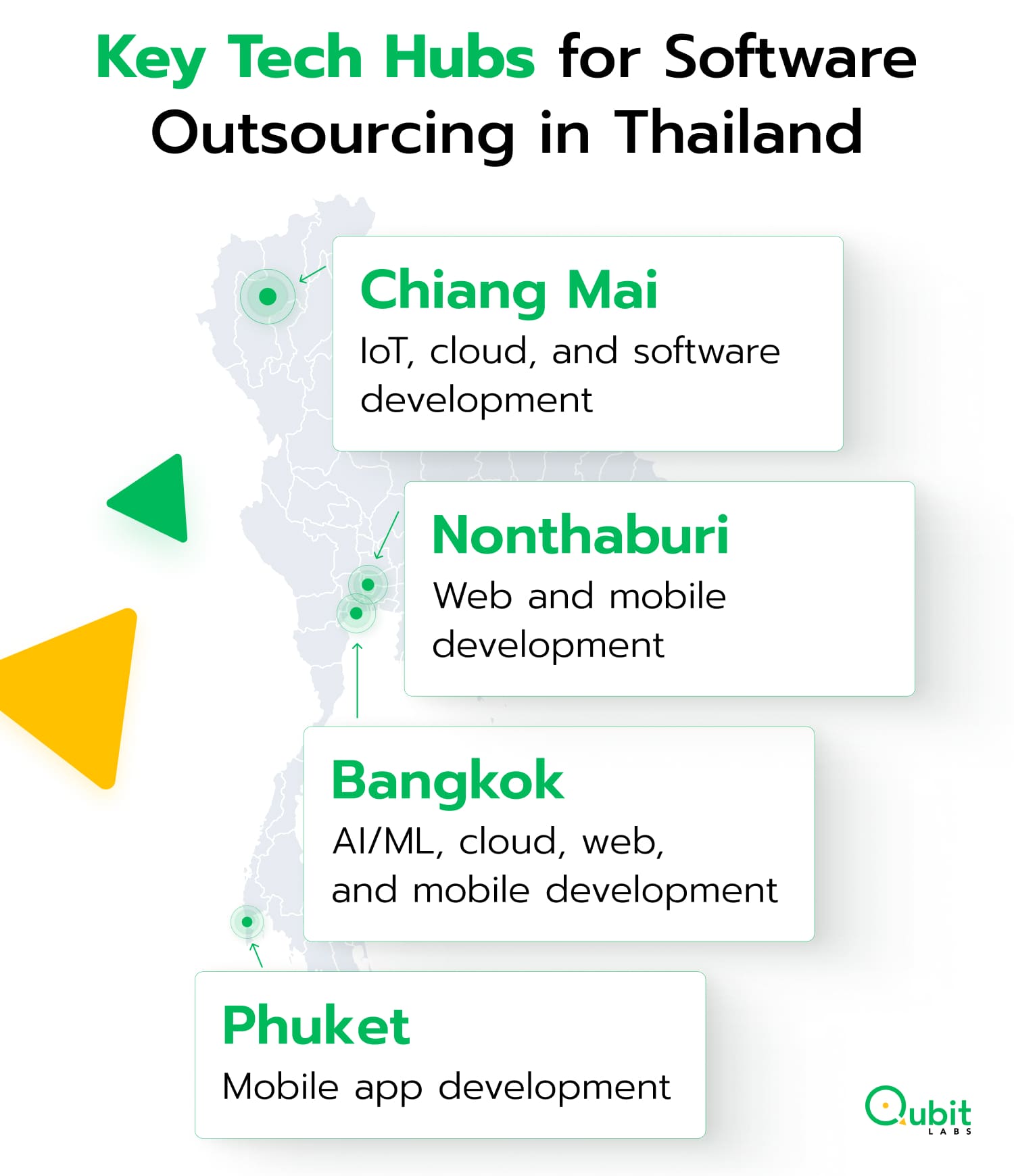
Thailand boasts a well-developed tech industry and a high concentration of skilled developers in its most prominent tech hubs, including Bangkok, Chiang Mai, Nonthaburi, and Phuket.
Bangkok
This is the country’s primary tech hub, offering diverse opportunities for tech companies. Google, Microsoft, and Apple have opened their R&D offices in this city. Bangkok is home to 60 custom software development companies and numerous fintech, e-commerce, and healthtech startups.
- Average salary: $22,200 per year.
- Tech expertise: AI/ML, cloud, web, and mobile.
Chiang Mai
Outsourcing software in Chiang Mai is a perfect option for companies seeking skilled developers with experience working with international companies in a remote setting. Numerous companies provide innovative solutions in custom software, web, and app development.
- Average salary: $13,300 per year.
- Tech expertise: IoT, cloud, and software development.
Nonthaburi
This tech hub comprises approximately 3000+ developers and 60 software development companies, offering services in AI development, custom software development, mobile and web development, cloud and big data consulting, and IoT development.
- Average salary: $14,700 per year.
- Tech expertise: Web, mobile, and AI development, as well as consulting services across various domains.
Phuket
This is an emerging hub with numerous tech startups and a diverse range of specialists with various skill levels. The Software Park Phuket offers multiple office spaces for rent, featuring high-speed Internet connections, which help companies enhance their research and development capabilities.
- Average salary: $37,840 per year.
- Tech expertise: Data analytics and mobile app development.
Key software development companies in Thailand include the following:
Qubit Labs is a prominent leader in the outstaffing industry. The company provides superior tech specialists for offshore software development in Thailand, delivering excellent results at competitive rates. The firm is recognized for its exceptional onboarding process, prompt responsiveness, effective communication, competitive pricing, and proactive approach.
Other reputable vendors are the following:
- Manao Software
- MeCode
- Rethink Lab
- Oivan
- Pimclick
- Outsourcify
Reasons to Choose Thailand for Offshore Software Development

According to Kearney’s 2024 Global Cities Index, Bangkok is ranked 34th globally. This country has a thriving economy and a rapidly developing startup ecosystem, with new firms appearing in e-commerce, fintech, logistics, and media sectors. Firms that choose to outsource software development in Thailand typically do so for the following reasons.
Competitive Rates
Significant reduction in operational costs is one of the major benefits of offshoring to Thailand. Local developers charge $25-$49 per hour; in the USA, rates are $50-$149, and in some cases, $300.
As for annual salaries, software developers in Thailand receive ~83% less than their counterparts in the USA. For instance, in Bangkok, the average yearly developer salary is $22,200, whereas the annual software engineer salary in the USA is $130,463. Therefore, if you are on a lean budget but need unique expertise, Thailand is the way to go.
Skilled Workforce
Seven universities in Thailand are ranked among the world’s top tech universities. Local developers are skilled in PHP, ASP.NET, Lua, Java, Node.js, Python, and Ruby. Besides, they are focused on upskilling and continuously enhancing their skills.
Robust Infrastructure
“Thailand’s foundation, such as its comprehensive infrastructure and digital technology, is already among the best in the region,” said Narit Therdsteerasukdi, secretary-general of the Board of Investment (BOI). The country boasts universal 4G/5G coverage, and through 2030, fixed broadband customers are expected to grow at a 3.8% annual rate. It has also attracted significant investment from TikTok, Google, and Amazon, which is improving local infrastructure.
Strong Government Support
The Thai government actively supports improving the population’s digital literacy and developing the tech industry. For instance, as part of its ongoing program, Microsoft Thailand launched the “THAI Academy: Accelerating Thailand’s AI Future” initiative to enhance the AI proficiency of more than 1 million Thais. Additionally, a Royal Decree provides a 50% income tax exemption on salary expenses, helping companies reduce operational costs and attract high-quality talent. Moreover, Thailand’s government has been supporting the growth of Thailand’s tech startup scene in key areas, including health, education, agriculture, and climate change.
Popular IT Outsourcing Services in Thailand
IT companies provide a wide range of services delivered under fixed-price, time-and-materials, and dedicated-team models. Software offshore Thailand enables companies to access specialized skills at competitive rates.
Custom Software and Web Development
The majority of companies offer these services to build enterprise systems, e-commerce platforms, and web applications, as well as solutions with integrated time tracking, to improve productivity and transparency.
Mobile App Development
These services typically encompass Android, iOS, and cross-platform development across industries such as fintech, edtech, e-commerce, healthcare, logistics, and gaming.
Cloud Consulting and DevOps Services
These services typically include cloud strategy, infrastructure assessment, migration (to AWS, Azure, or GCP), CI/CD automation, infrastructure automation, and ongoing infrastructure management.
Cybersecurity Services
Software outsourcing companies in Thailand offer a range of services, including penetration testing, vulnerability assessments, and compliance checks across industries such as healthcare, finance, and retail.
AI Development
This is a growing niche that encompasses algorithm development, data cleaning, AI integration with existing systems, performance monitoring, and the building of custom AI solutions (e.g., chatbots, image analysis, scheduling assistants, and more).
Challenges of IT Outsourcing to Thailand (And How to Overcome Them)

Although software development outsourcing in Thailand has numerous benefits, some key considerations should be assessed before implementing an outsourcing strategy. Qubit Labs has extensive experience building dedicated teams worldwide, and we have some valuable tips you can use to make software development outsourcing in Thailand a success.
Communication Barriers
According to the EF English Proficiency Index,Thailand ranks 106th out of 116 countries, indicating very low English proficiency. Software engineers typically have stronger English proficiency than other tech specialists; however, English proficiency should still be carefully evaluated.
Solution:
If you hire developers without external assistance, check their skills through video interviews. Additionally, when collaborating with Thai developers, ensure that you have established clear communication channels for both synchronous and asynchronous communication (e.g., Google Meet, Zoom, Slack, Jira, Trello). Also, ensure all team members are aligned and work towards achieving the same goal.
If you work with an outstaffing company, ensure they provide only vetted candidates across hard and soft skills. This guarantees you interview only qualified candidates, which accelerates hiring and reduces hiring costs.
Talent Shortage
There is a significant lack of qualified workers in Thailand’s digital industry; only 0.58 million people, or 1% of the country’s total population, possess digital skills. Additionally, the pace of adoption of cutting-edge technologies is slower than in Eastern Europe.
Solution:
You can hire local engineers after conducting a comprehensive analysis of their expertise, relevant experience, and establishing quality benchmarks. Alternatively, you can consider other outsourcing destinations with large talent pools, such as Vietnam and Indonesia. However, communication and quality issues may still occur.
Therefore, we recommend choosing Eastern Europe as a destination for outsourcing software development due to its vast pool of 1,200,000 developers with expertise in Artificial Intelligence, Machine Learning (ML), gaming, and custom software development. Additionally, they align perfectly with Western business practices and possess high English proficiency.
Cybersecurity & Data Protection Issues
In the first half of 2025, Thailand recorded 21,000 cyberattacks. Therefore, collaborating with Thai vendors can be challenging for security-sensitive companies.
Solution:
Ensure the vendor you work with conducts regular threat analysis and ongoing patch management, implements the latest security protocols, and is ISO 27001/PDPA-certified. Besides, always sign a non-disclosure agreement (NDA) and conduct regular security audits.
Cultural Differences
One of the priorities for Thai software engineers is “sanuk” or “sanook.” This concept encompasses the enjoyment and excitement experienced in various activities, including work tasks. Therefore, they thrive in environments where coding isn’t just a routine duty but an enjoyable experience.
Additionally, they prioritize hierarchy and seniority, with senior staff members making the most critical decisions. Communication is indirect; the work culture is cooperative, and a strong emphasis is placed on maintaining a balance between work and life and on family relationships.
Solution:
To guarantee seamless collaboration, minimize cultural misunderstandings, and boost employee engagement, implement cross-cultural training. You can also host regular meetings to enhance trust and provide the necessary support.
How to Choose the Right IT Outsourcing Partner in Thailand

Follow these five steps to find a trusted partner to build an offshore development team in Thailand.
Define Your Requirements
Define the type of service you want to outsource. It can include cybersecurity consulting, custom software development, AI development, QA services, and more. At this stage, it’s also essential to create a short list of requirements (e.g., your business objectives, the project scope, team composition, timelines, budget, and other criteria).
Conduct Market Research
To find potential partners with industry-relevant experience, consider using Clutch or GoodFirms. These platforms offer comprehensive information on the client’s industry focus and service range, and include client reviews that provide insights into the company’s working style and business culture. We also recommend reviewing case studies on the vendor’s website to determine whether the firm has the necessary experience in your business vertical and can deliver the solutions you need.
After this comprehensive assessment, shortlist the vendors and compare their proposals.

Evaluate the Vendor’s Expertise
To ensure a company can meet all your requirements and deliver outstanding solutions, check the following:
- Expertise in the tech stacks you need, combined with hands-on experience in similar projects, guarantees smooth development and innovative solutions.
- Relevant certifications (e.g., AWS Certified Developer – Associate, AWS Certified DevOps Engineer, CSSLP (Certified Secure Software Lifecycle Professional), and Certified Scrum Developer (CSD)) back up the developers’ technical knowledge.
- Adherence to industry regulations and the latest security standards ensures the confidentiality of personal data and the development of secure and scalable solutions.
- Scalability and flexibility. Ensure your future partner can handle increased workloads and has access to a vast pool of developers to scale your resources up or down when needed.
- Responsiveness and transparent communication ensure smooth development and timely delivery.
- Cultural compatibility and English proficiency are crucial for creating a positive work environment, minimizing misunderstandings, and promoting team cohesion.
- Project management methodologies (e.g., Scrum, Agile) should match your internal workflows for seamless integration. Also, ensure that a company offers time zone alignment.
- A transparent pricing model, such as a time-and-materials, fixed-price, or dedicated-team model, should align with your budget. Additionally, ensure that there are no hidden fees.
Start with a Pilot Project
After you have chosen your future partner, consider trying the company’s services before making a long-term commitment. Qubit Labs, for instance, offers a two-week free trial recruiting that allows you to assess our work approach, our reliability, speed, and the quality of candidates provided. Before searching for skilled professionals exclusively for your request, we sign a non-disclosure agreement (NDA) to protect your information.
Finalize an Agreement & Get to Work
Discuss all terms and conditions to clarify deliverables, specify all deadlines, expenses, and legal obligations. After that, your partner will provide top-tier developers to meet your request for expanding in-house opportunities or building a dedicated team to manage your project from idea to launch. Besides, a reliable business affiliate will support your growth plans and provide additional resources when needed.
Comparing Thailand with Other Software Outsourcing Destinations
Companies that plan to build an offshore development team in Asia usually consider India, Vietnam, and the Philippines for outsourcing. These popular destinations have their own merits, especially for businesses seeking specialized skills at competitive rates. Clients from North America seeking perfect communication skills and cultural affinity hire LATAM developers. Companies that want to access niche skills at affordable rates usually outsource software development to Romania or decide to build a dedicated development team in Poland.
However, software development outsourcing to Thailand can be a perfect alternative for businesses that want to tap into an extensive talent pool and reap all the benefits of a robust digital infrastructure and various tax incentives.
Let’s compare Thailand with other top outsourcing destinations globally to see what benefits you get when choosing this country for hiring outsourced software engineers.
| Factor | Thailand | Vietnam | Romania | Mexico |
|---|---|---|---|---|
| Labor costs | Competitive. The hourly rate ranges from $25 to $49 per hour. | Attractive. Developers charge between $25 and $49 per hour. | Affordable. The hourly rate ranges from $25 to $49 per hour. | Cost-effective rates – $25-$49 per hour. |
| Hidden costs | Moderate overhead. | Emerging IP policies. | A solid EU infrastructure. | IP concerns. |
| English proficiency (EF score) | Very low (#116 out of 123) | Moderate (#64 out of 123) | Very high (#11 out of 123) | Very low (#103 out of 123) |
| Time zone alignment | GMT+7, perfect for Asia and Australia | GMT+7, great for Asian and Australian markets, and the U.S. market (with overlapping business hours) | GMT+2, excellent for the EU | GMT−6 to −8, a perfect nearshoring destination for the USA |
| Cultural affinity | Moderate alignment with Western business practices | Medium to high compatibility with Western markets | Perfect culture alignment | Perfect affinity with the US |
| Talent pool size | 550,000+ IT specialists | 1,260,000 | 250,000 | 800,000 |
| Tech proficiency | PHP, Lua, ASP.NET, Java, Node.js, and Python | Python, Java, JavaScript, C#, PHP, and React | JavaScript, Python, Java, C#, React, and Angular | JavaScript, Python, Java, SQL, C++, and React.js |
| Industry specialization | Mobile, web, AI, and IoT development | E-government and smart cities | Fintech, cybersecurity, and healthtech | Fintech, healthtech, e-commerce, and gaming |
| Digital infrastructure | High in tech hubs, improving in regional centers | Rapidly growing | Highly developed | Strong urban connectivity |
| Data security | Moderate IP protection | Cybersecurity issues | Strong EU data regulation | A solid legal framework, yet some security issues can arise |
| Economic stability | Stable economy | Robust GDP growth | Stable economy | Moderate volatility |
Therefore, if you have a security-sensitive project that requires real-time collaboration and plan to visit your team on-site, consider Mexico as a perfect nearshoring destination. If you need talented developers with strong English proficiency, expertise in the latest technologies, alignment with Western business practices, and GDPR compliance, choose Romania.
Vietnam is an ideal choice for companies that prioritize competitive rates and solid infrastructure development. Thailand is an emerging destination for companies looking for tech talent with improving English skills.
Qubit Labs provides exceptional IT staff augmentation services for companies of all sizes across various industries. For businesses that prioritize robust data protection, a perfect price-to-quality ratio, and tech talent that drives innovation, Eastern Europe should be considered their primary destination for outsourcing. Local outsourcing companies excel in remote collaboration, providing cutting-edge solutions on time and at reasonable costs.

Discover IT Outsourcing Thailand with Qubit Labs
Hence, Thailand has a rapidly growing IT outsourcing market, with tech giants such as Google and TikTok investing billions of dollars in local infrastructure. This country is an ideal location for businesses seeking to expand their reach into new markets, reduce costs, and collaborate with a skilled workforce. However, companies can face various challenges, including communication, quality assurance, and cybersecurity issues.
To mitigate all risks and find professional developers in Thailand, it is essential to engage a reliable service provider that can provide high-quality candidates and effectively navigate all legal, administrative, and other challenges. Qubit Labs can source top-tier talent with the required expertise in a desired location and land a perfect dedicated team within weeks. Let’s discuss how we can transform your business during a free consultation call.