AI development is advancing at an unprecedented pace, with model capabilities doubling every four to seven months, according to Anthropic. Businesses are moving from AI experimentation to embedding AI-powered solutions into their core workflows. As a result, new AI roles are emerging in 2026. AI agent developers, n8n specialists, and LangChain engineers barely existed a couple of years ago, but now they show up in the job requests we review every day.
New roles created by AI are shifting the hiring focus in 2026. In this article, we’ll share what we see on the ground: new AI roles and skills in demand, what’s driving this hiring shift, interview questions to assess the expertise of advanced specialists, and where to find them and at what cost. All insights are based on our day-to-day experience sourcing tech talent and help you assess your company’s AI hiring readiness and adjust talent acquisition strategies required to hire n8n developers and other niche specialists.
AI Agent Developer: The Role Building Autonomous Software
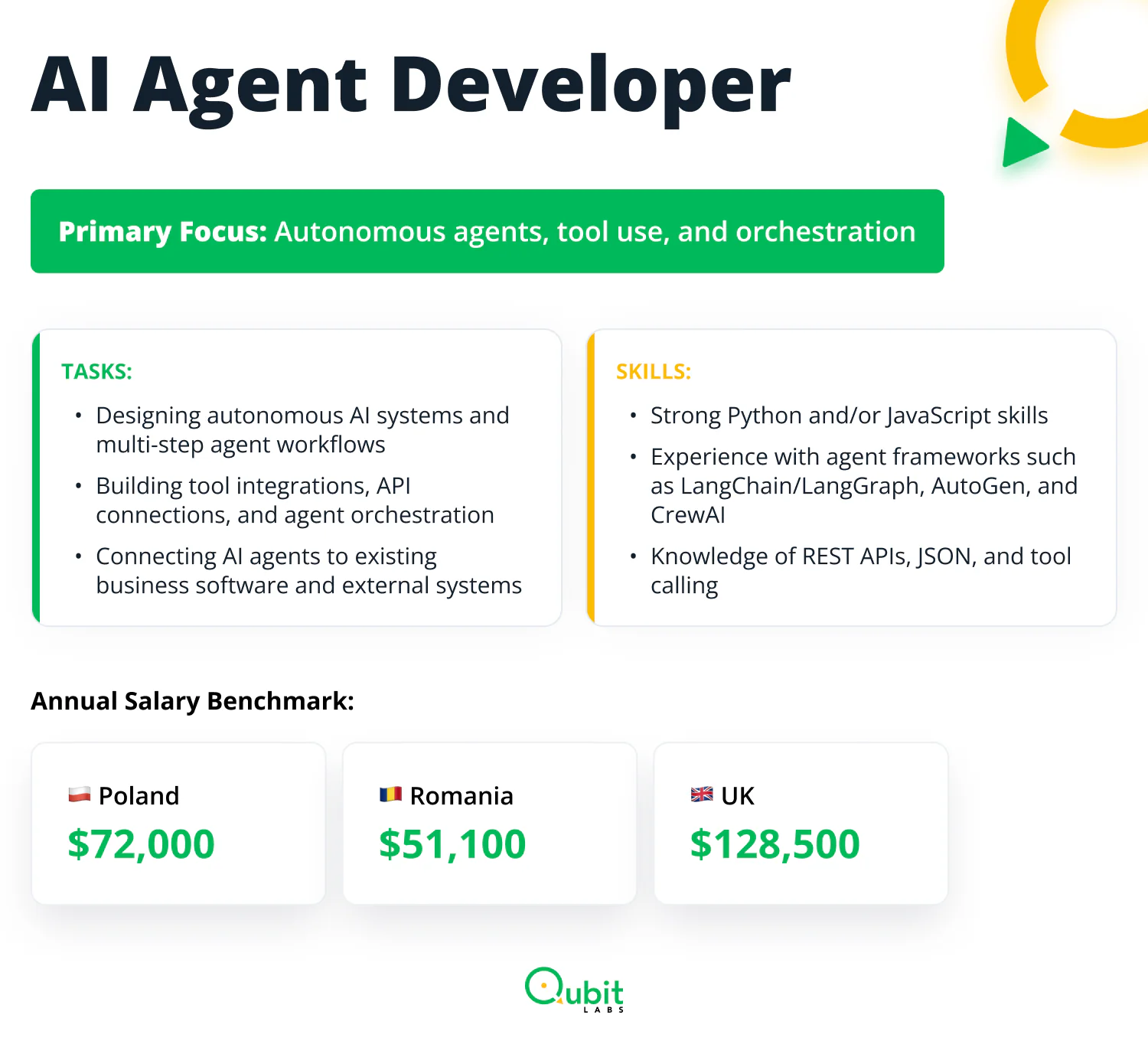
In 2026, Agentic AI is the next frontier. Elementor says integrating systems that can plan, reason, and handle multi-step tasks on their own is the biggest trend. As a result, companies prioritize hiring new job roles, such as AI agent developers, who can design software that makes decisions using large language models (LLMs), machine learning, and smart reasoning, and calls tools with minimal human input.
What an AI Agent Developer Actually Does
Companies hire AI agent engineers who design autonomous AI systems, build tool integration and API connections, connect AI agents to existing business software, implement safety protocols, and test real-world edge cases.
- Daily activities: Connecting LLMs to APIs, building agents that handle customer support tickets end-to-end, orchestrating multi-agent workflows, or automating data entry across internal systems.
- Frameworks used: LangChain, LangGraph, AutoGen, LlamaIndex, and CrewAI.
What a Real AI Agent Developer Job Description Looks Like
In our experience, companies hiring for this new AI agent job role in 2026 seek specific expertise, experience, and certifications. We’ve analyzed over a dozen job descriptions, and here’s what companies are actually asking for:
- Core skills: Strong Python and/or JavaScript programming skills, proficiency in Agent Skills, SKILL.md, and Managed Agents, knowledge of multi-agent orchestration and workflow automation, proficiency in LangChain, LlamaIndex, AutoGen, or similar frameworks, familiarity with JSON, REST APIs, and SSE/streaming data patterns, strong hands-on skills in prompt design, workflow building, and API integration.
- Soft skills: Strong problem-solving skills, self-motivation, passion for learning, strong communication skills, and ability to work in multi-disciplinary and fast-moving environments.
- Certifications: Microsoft Certified: AI Agent Builder Associate (AB-620), GitHub Certified: Agentic AI Developer (GH-600), IBM RAG & Agentic AI Professional Certificate, and other relevant AI/ML certifications.
- Nice-to-have skills: Experience with AI/LLM-based platforms, experience with TypeScript, AWS, and Ruby on Rails, and practical knowledge of building and refining LLM agents, prompts, and RAG pipelines.
Interview Questions to Screen AI Agent Developers
In our experience, it may be challenging to hire an AI agent developer if you don’t know which questions to ask to distinguish a fair match from a superior match. Here are three key questions our recruiters use in the interview process to filter out unsuitable candidates and hire someone to build an AI agent in weeks, not months.
- “How would you design an agent that needs to complete a multi-step task involving external tools? Walk me through the process.” – This question helps evaluate architectural thinking, not just framework proficiency.
- “How do you design tools for an AI agent, and what makes a tool reliable and safe?” — If you wonder how to hire an AI agent developer who can turn an LLM into a dependable system by analyzing tool selection, input validation, permissions, and predictable outputs, this question will provide the necessary insights.
- “How do you evaluate and test an AI agent?” — This question separates strong engineers from exceptional ones, showing how they can test edge cases, measure quality, and trace failures.
Salary and Where to Find AI Agent Developers
In our practice, tech businesses not only wonder how to hire an AI agent for research tasks, but also where to find them so they can onboard quickly and meet budget expectations. Here are the top countries where you can hire new roles for AI without spending months on sourcing and tens of thousands on salaries.
| Country | Median AI Agent Developer Salary (Annual) | Hiring Timeline |
|---|---|---|
| Poland | $72,000 | 3-8 weeks |
| Romania | $51,100 | 6-10 weeks |
| Ukraine | $31,000 | 4-8 weeks |
| United Kingdom | $128,500 | 6-12 weeks |
| Germany | $110,215 | 6-12 weeks |
* Data is sourced from remoteria.com, itjobswatch.co.uk, and salaryexpert.com
Our insights: From a hiring perspective, location has a major impact on AI agent developer costs. Eastern Europe offers experienced AI talent at lower salary levels than Western Europe or the US. Ukraine is the most cost-efficient option, while Poland is a strong choice when access to a mature talent pool is a priority. However, AI salaries in Poland are rising steadily, from 60% growth for entry-level roles to 5.9% for senior-level talent. Median pay has increased 20% over the last six months.
What Qubit Labs offers:
To cut hiring time and access top-tier talent at competitive costs, you can partner with our staff augmentation company. With a strong presence across Eastern Europe, access to a pool of 100,000+ developers, and established evaluation and hiring frameworks, we can find the right match in weeks. We work across fintech, healthtech, retail, e-commerce, education, logistics, and other industries and can place the right developer without administrative overhead.
LangChain Engineer: RAG Pipelines, Production AI, and LangGraph
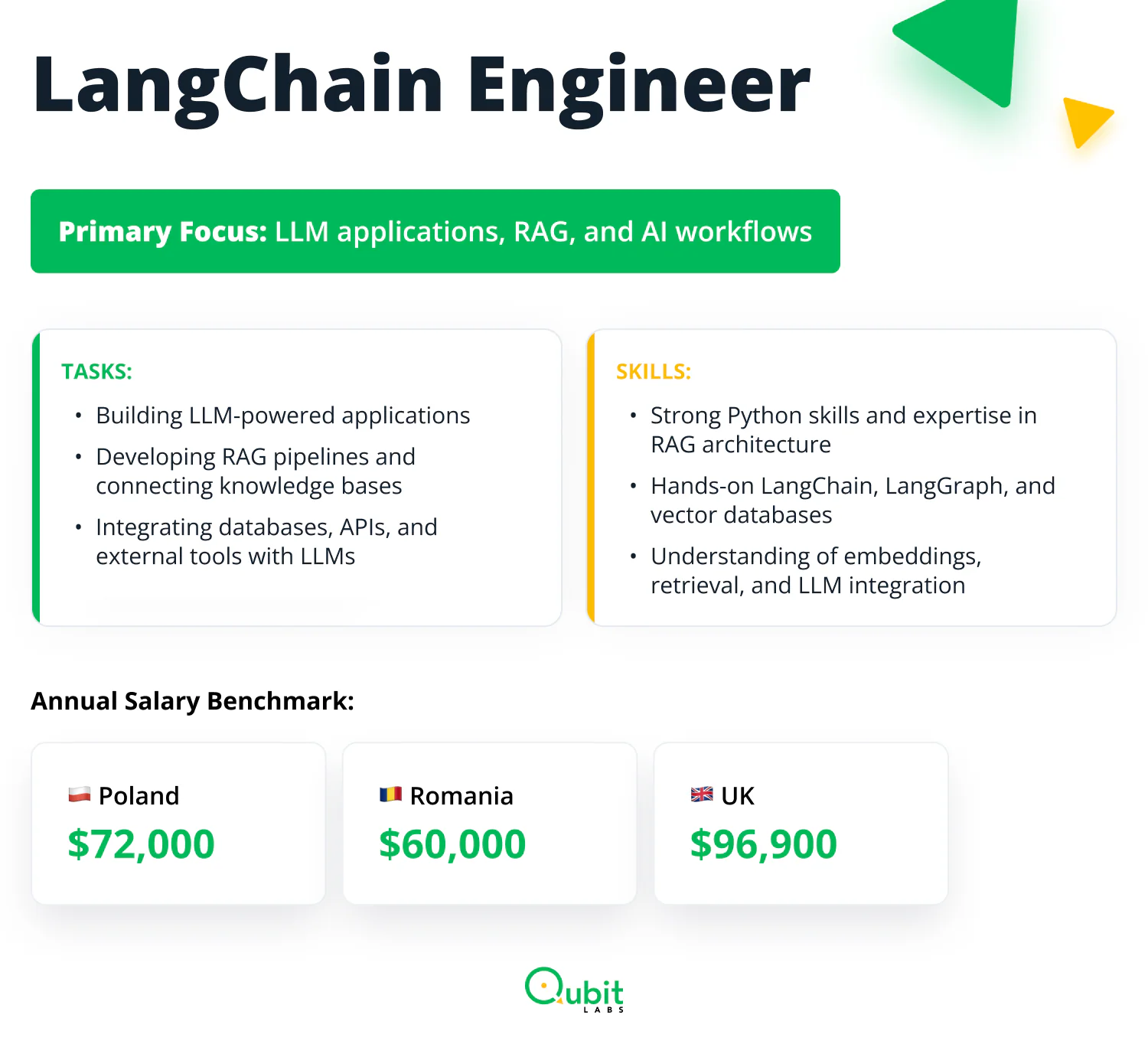
According to LangChain’s State of Agent Engineering Report, 26.5% of companies build AI agents primarily for customer service. That’s where experienced LangChain developers who build retrieval-augmented generation (RAG) pipelines and production-ready LLM applications within the LangChain ecosystem come in. Unlike Python developers, this new AI job role prioritizes hands-on experience with vector retrieval and LLM orchestration frameworks.
What a LangChain Engineer Does
ZipRecruiter states that LangChain developers, considered one of the emerging AI roles and skills in demand in 2026, build LLM-powered applications, design AI workflows, and create natural language processing tools. They build enterprise knowledge assistants, customer support systems, document-processing systems, and AI copilots.
- Daily activities: Developing RAG pipelines and connecting knowledge bases, integrating databases, APIs, and external tools with LLMs, and testing and optimizing agent performance.
- Frameworks used: LangChain, LangGraph, LangSmith, Semantic Kernel, LlamaIndex, and Haystack.
LangChain vs LangGraph: What Engineers Actually Need To Know
Companies hire LangChain developers with strong knowledge of both LangChain and LangGraph. However, they serve different use cases. Here is a brief comparison to help you understand which expertise to prioritize based on your objectives and business goals.
| Aspect | LangChain | LangGraph |
|---|---|---|
| Core focus | RAG, prompts, tools, and chains. | Agent orchestration and workflows. |
| Strengths | Fast development and integration. | Fine-grained control over agent behavior. |
| Best suited for | Building focused LLM applications and streamlined AI workflows. | Orchestrating complex agents with planning, iterative loops, and human oversight. |
| Use cases | RAG apps, copilots, and chatbots. | Autonomous agents, multi-agent systems, and complex workflows. |
What A Real LangChain Engineer Job Description Looks Like
Clients who contact Qubit Labs typically have specific needs for new AI job roles emerging in 2026. Here are requirements drawn from 15+ job postings we’ve received recently.
- Core skills: Strong Python skills, hands-on LangChain and LangGraph expertise, RAG architecture expertise, solid understanding of SQL, familiarity with Pinecone, Weaviate, and FAISS, a solid grasp of prompt engineering, and production deployment experience.
- Soft skills: Strong problem-solving, communication, collaboration, and analytical thinking skills.
- Certifications: LangChain Certified Agent Engineer, cloud AI/ML, and relevant LLM/GenAI certifications.
- Nice-to-have skills: Basic understanding of a specific domain, experience with Azure, AWS, and GCP, familiarity with Docker, Git, and CI/CD pipelines.
Salary and Where to Find a LangChain Engineer
Agentic Engineering Jobs analyzed 534 agentic AI engineering job listings and found that LangChain appears in 34.3% of all listings, making it the most frequently requested framework. Demand is high, and the role is one of the fastest-growing in the market, but a severe senior skill gap remains. As a result, companies are exploring new strategies on how to hire a LangChain developer and where to source this talent quickly. Here are the top talent hubs where we hire LangChain experts for our clients.
| Country | Median LangChain Developer Salary (Annual) | Hiring Timeline |
|---|---|---|
| Poland | $72,000 | 4-8 weeks |
| Romania | $60,000 | 2-8 weeks |
| Ukraine | $43,200 | 3-8 weeks |
| United Kingdom | $96,900 | 10-14 weeks |
| Germany | $125,000 | 6-12 weeks |
* Data is based on Qubit Labs’ research, agentic-engineering-jobs.com, and salaryexpert.com
Our insights: Ukraine offers the strongest value for companies planning to hire LangChain programmers, at roughly a third of Germany’s cost. Poland and Romania, in turn, offer a middle ground for companies balancing cost efficiency and talent maturity. However, low cost doesn’t equal fast hiring. Remember, talent pools for new AI roles are limited, even in cost-efficient markets. In this case, partnering with a reputable staff augmentation company with a vetted talent pool can really make the difference.
n8n Specialist: The Workflow Automation Engineer Replacing 10 Manual Processes
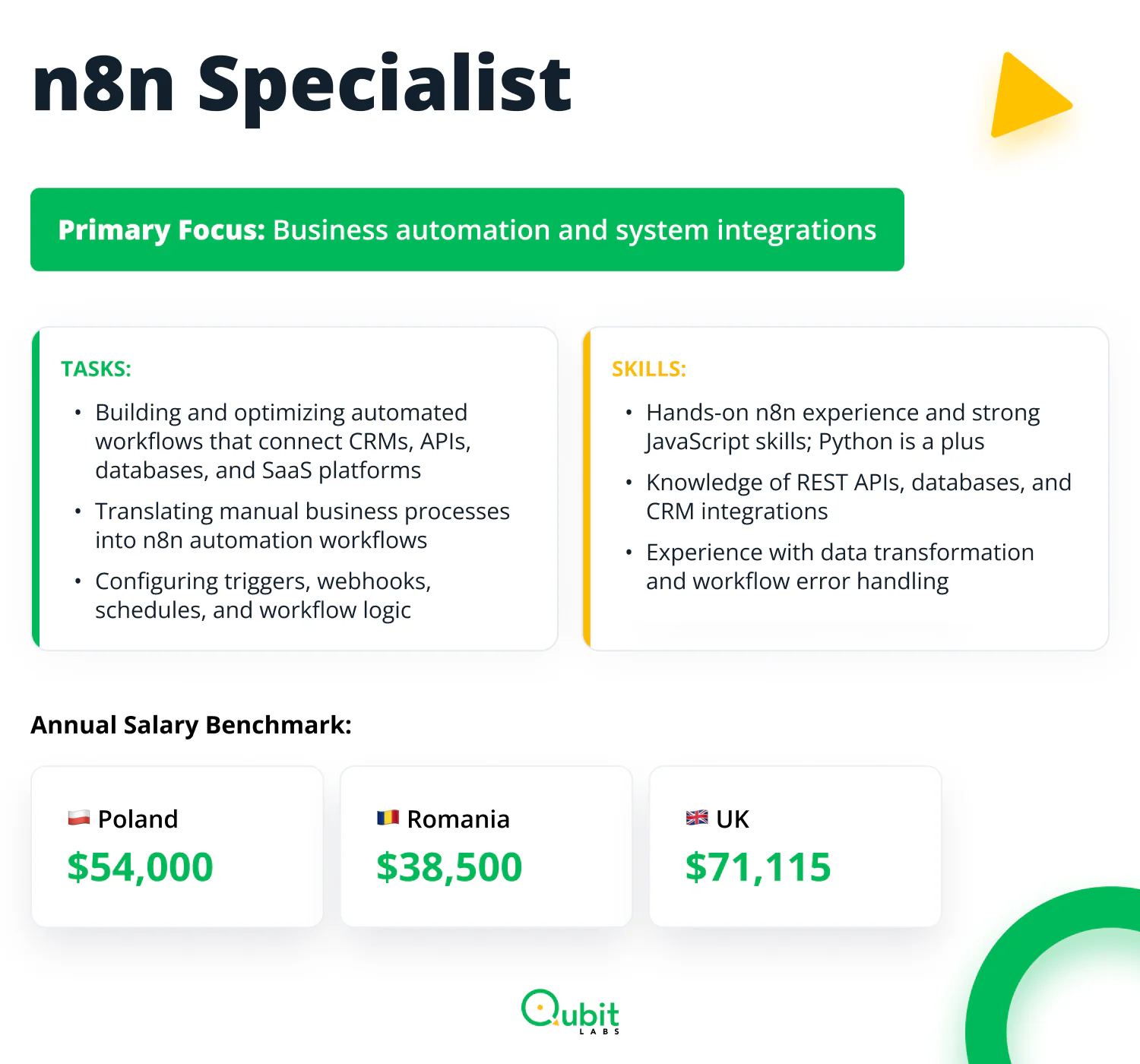
According to job creation statistics for new AI roles from Revelio Labs, n8n recorded 1,058 job postings in Q1 2026, compared with 3,516 throughout 2025, averaging roughly 293 new positions per month. The adoption of low-code infrastructure, combined with AI tools, drives demand for n8n specialists.
What an n8n Specialist Does
Upwork reports that an n8n expert builds and optimizes automated workflows that connect CRMs, APIs, and databases to streamline operations and eliminate repetitive tasks. Companies hire n8n experts to build low-code automations that cut manual work and development costs.
- Daily activities: Mapping manual business processes into n8n automation workflows, configuring triggers, webhooks, and scheduled n8n automation runs, building n8n integrations, testing n8n integrations for edge cases and failure scenarios, and monitoring and troubleshooting broken workflows.
- Frameworks used: n8n, Express.js, Docker, and REST/GraphQL APIs.
n8n vs Make vs Zapier: When to Choose Which
| Aspect | n8n | Make | Zapier |
|---|---|---|---|
| Flexibility | High. | Medium-High. | Medium. |
| Technical skills required | Moderate to advanced. | Low to moderate. | Minimal. |
| Customization | Extensive. | Good. | Limited. |
| AI workflows | Advanced. | Advanced. | Strong. |
| Cost at scale | Low. | Moderate. | Expensive as volume grows. |
| Best suited for | Complex workflows requiring customization. | Visual multi-step automation. | Simple integrations. |
| Ideal hire | n8n specialist. | Automation specialist. | An expert is rarely needed. |
When to choose n8n developers for hire: for complex workflows that require custom logic, need to be integrated with internal systems, and need to be scaled cost-efficiently. Make is a good option for visually complex, multi-step workflows with data transformations and integrations that don’t require n8n’s self-hosting capabilities. Zapier suits simple and low-volume integrations.
What a Real n8n Specialist Job Description Looks Like
An n8n specialist is becoming one of the most in-demand AI roles. Here’s what companies are seeking in these experts, based on Qubit Labs’ internal analytics.
- Core skills: Hands-on n8n experience, strong JavaScript and/or Python skills, foundational knowledge of APIs, workflows, and automation platforms, experience with databases and CRMs, and familiarity with REST APIs and webhooks.
- Soft skills: Strong analytical thinking, attention to detail, clear communication, and problem-solving skills.
- Certifications: No formal certifications currently exist.
- Nice-to-have skills: Experience with LLMs, AI agents, and cloud infrastructure.
Interview Questions to Screen n8n Specialists
To efficiently hire offshore AI developers skilled in n8n, you should focus on interview questions assessing technical expertise, architectural judgment, real workflow design thinking, and other relevant skills and competencies. Based on the role requirements, you can choose any of these questions.
- “How would you design an n8n workflow that integrates multiple APIs and handles data transformation between them?” — tests workflow design and API integration skills.
- “How do you handle errors and failures in an n8n workflow?” — evaluates error-handling strategies, troubleshooting skills, and understanding of production-ready automations.
- “When would you use a Code node instead of a built-in n8n integration?” — tests knowledge of n8n capabilities and ability to choose between custom code and native features.
Salary and Where to Find n8n Specialists
In our experience, the right hiring location can offer significant cost savings while ensuring process reliability and smooth future team expansion. Here are the best places to hire n8n developers and build an AI development team that drives measurable results.
| Country | Median n8n Developer Salary (Annual) | Hiring Timeline |
|---|---|---|
| Poland | $54,000 | 3-8 weeks |
| Romania | $38,500 | 3-8 weeks |
| Ukraine | $37,200 | 2-8 weeks |
| United Kingdom | $71,115 | 6-10 weeks |
| Germany | $68,600 | 6-10 weeks |
* Data is based on remoteria.com, itjobswatch.co.uk, and devjobs.de
Our insights: Eastern European markets offer the strongest cost-to-speed ratio for companies figuring out how to hire n8n developers. Ukraine and Romania combine competitive salaries with fast hiring timelines. Building a development team in Poland is also more affordable and notably faster than in the UK or Germany.
If you choose outsourcing to Eastern Europe through Qubit Labs, you can be sure that we deliver strong candidates chosen based on structured and semi-structured interviews with domain experts and place them within weeks, not months.
Salary Comparison: All Three Roles at a Glance
We are seeing how AI is changing developer roles. Developers are shifting from writing code alone to AI-assisted development, system design, integration, and higher-level problem-solving, reshaping hiring priorities.
Companies are seeking developers who can build solutions with AI, integrate models, and make architectural decisions. Eastern Europe offers a strong combination of experienced engineering talent, strong AI expertise, and cost efficiency. These factors make the region an attractive location for AI staff augmentation, hiring AI agent developers, MLOps developers, LangChain engineers, and other specialists.
The region offers a significant cost advantage alongside strong technical expertise. Here are salary benchmarks across top tech hubs in Eastern Europe and cost savings compared to the USA.
| Country | Median AI Agent Developer Salary | Median LangChain Engineer Salary | Median n8n Specialist Salary |
|---|---|---|---|
| Poland | $72,000 | $72,000 | $54,000 |
| Romania | $51,100 | $60,000 | $38,500/td> |
| Ukraine | $31,000 | $43,200 | $37,200 |
| Bulgaria | $45,000 | $52,750 | $45,300 |
| US | $131,000 | $165,000 | $125,000 |
* Data is based on Qubit Labs’ research, remoteria.com, itjobswatch.co.uk, salaryexpert.com, levels.fyi, and ziprecruiter.com
Our insights: Ukraine delivers the highest cost savings compared to the US (70-76%). Romania also offers significant savings for n8n specialists (69% compared to the US). Bulgaria falls in the middle, offering cost savings ranging from 64% to 66%. Poland consistently offers the smallest gap (45%-57%), though it’s still substantial. Notably, LangChain engineers command a premium over AI agent developers in nearly all markets, giving you the information you need to decide which role to prioritize first.
Which Role Do You Actually Need?
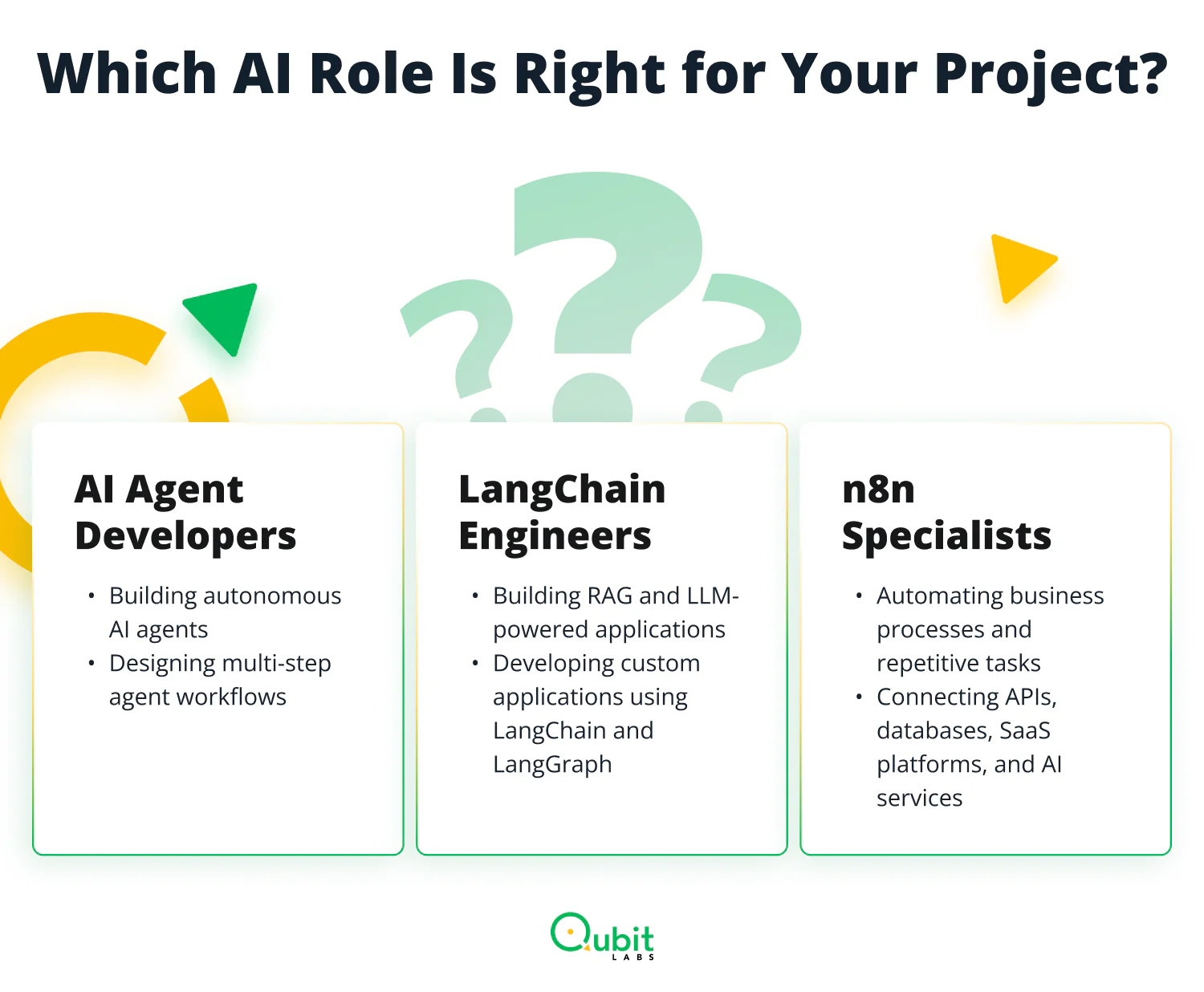
Staying on top of AI industry trends and emerging roles matters, but choosing the right one depends on how complex your automation needs are. Beyond technical expertise, your project may require knowledge of AI ethics, particularly when agents process sensitive data or interact with users directly.
Here is a brief checklist to help you choose the right option.
- Hire AI agent engineers if you need systems that reason, plan, and take multi-step actions with minimal human input.
- Hire remote LangChain developers if you plan to build LLM-powered features like RAG-based search, copilots, or context-aware chat experiences.
- If you need to automate structured business processes and integrations without heavy custom logic, hire n8n developers.
You can also hire all three specialists for different purposes. AI agent developers will orchestrate complex, autonomous decision-making systems; LangChain engineers will handle LLM integrations; and n8n specialists will manage operational automation.
“What we see is that many companies struggle to match the role with the actual complexity of the problem. The most common mistake is hiring AI agent developers for tasks that n8n specialists can solve faster or cheaper, or hiring n8n experts to handle complex reasoning. The key is to look beyond the buzzwords and focus on the actual project requirements,” says Iva Kozlovska, CEO of Qubit Labs.
Where to Find These Specialists and How Long It Takes
Artificial intelligence agent developers, LangChain engineers, and n8n specialists are still narrowly defined roles. Therefore, the hiring timeline depends on seniority and project requirements. Direct sourcing can take up to 14 weeks or even longer.
The most common sourcing channels are:
- GitHub/GitLab, since they provide histories and contributions that signal real-world production experience.
- Vetted talent networks (e.g., TopTal, Turing, and more) provide access to pre-screened talent, saving you screening time.
- Professional developer communities on Discord and Reddit help you find active builders and domain experts.
- Freelance marketplaces, such as Upwork, offer a high volume of engineers, but you still need internal technical vetting.
- Slack channels, such as DataTalksClub and MLOps Community, offer structured discussions and have a strong presence of senior talent.
In our experience, the best option is to partner with an experienced staff augmentation company since it has a strong pipeline of pre-vetted engineers and delivers faster results. Qubit Labs has over ten years of experience in building and scaling development teams, and clients consistently emphasize our personalized approach, transparent pricing, and streamlined hiring.
One of our clients, a SaaS company, stated that
“The Qubit Labs developers consistently deliver on sprint commitments and integrate well with our existing team. They’ve helped us maintain development velocity and ship features on schedule while keeping our engineering costs manageable compared to US-based hiring.
Moreover, we’ve been able to increase our development capacity and maintain consistent release cycles without the overhead of full-time US-based hires.”
Why Eastern Europe for AI automation roles in 2026
Our hands-on recruiting experience across Eastern Europe shows that the region has become a leading source for hiring these niche specialists. Several factors explain why:
- Growing specialization. A growing pool of experts specializes in AI agents, LLMs, LangChain, and n8n.
- Strong engineering background: Local engineers combine AI expertise with strong software development and cloud skills.
- Cost efficiency: Salaries for niche specialists are 45-76% lower than in the US.
- Time zone overlap: The region offers a convenient time-zone overlap with Western Europe and the US East Coast.
- Proven remote-work culture: Eastern European engineers have high or very high English proficiency, according to the EF English Proficiency Index, and are accustomed to working in distributed teams and with international clients.
Not sure which country to choose? We’ve got a solution. Here are the most popular talent hubs, based on dozens of partnerships.
- Poland stands out for production-oriented AI engineering and has active demand for agentic AI, RAG, and LangChain/LangGraph. It also has a vast pool of AI and Python engineering talent, with over 50,000 AI engineers, according to our latest AI Developer Hubs Report.
- Ukraine ranks 40th out of 195 countries in the Government AI Readiness Index 2025 by Oxford Insights and has one of Eastern Europe’s strongest AI developer pools. It has a growing pool of n8n expertise and offers specialists proficient in APIs, LLMs, JavaScript, and Python. Local talent also combines LangChain/LangGraph expertise with experience building production-grade agentic systems.
Realistic Hiring Timelines – Why Starting Early Matters
Even in cost-efficient markets, hiring niche specialists can take time. Hiring AI agent developers and LangChain engineers can take up to 8 weeks because these skill sets are still rare. Finding suitable n8n specialists takes less time (up to 4-6 weeks) because the talent pool is broader.
However, timing isn’t actually the real obstacle. The main problem is that they don’t build talent pipelines, ignore talent mapping, and start searching only when project deadlines are imminent. Many companies still don’t realize that even in talent-rich markets like Eastern Europe, developers with specialized skills don’t stay available for long.
What’s the solution? Identify your requirements and goals early and start searching for a suitable developer once your project is greenlit. In practice, it can save you months of searching and thousands on budgeting. Do you want to discover the best hubs for hiring this talent, conduct talent mapping, or build an AI automation team without delay? Qubit Labs owns the process end-to-end so that you can get the desired result in weeks. Schedule a free consultation call, and let’s discuss the details.